ADPD188BI Series
Integrated Optical Module with Ambient Light Rejection and Two LEDs
Manufacturer: Analog Devices
Catalog
Integrated Optical Module with Ambient Light Rejection and Two LEDs
Key Features
• Supports UL-217 edition 8/ UL-568 ed. 7; EN-54; GB..; ISO
• Lowers Nuisance Alarms using a Dual Wavelength detection with higher SNR and dynamic range.
• 3X Lower power dissipation enables smaller/ cheaper batteries
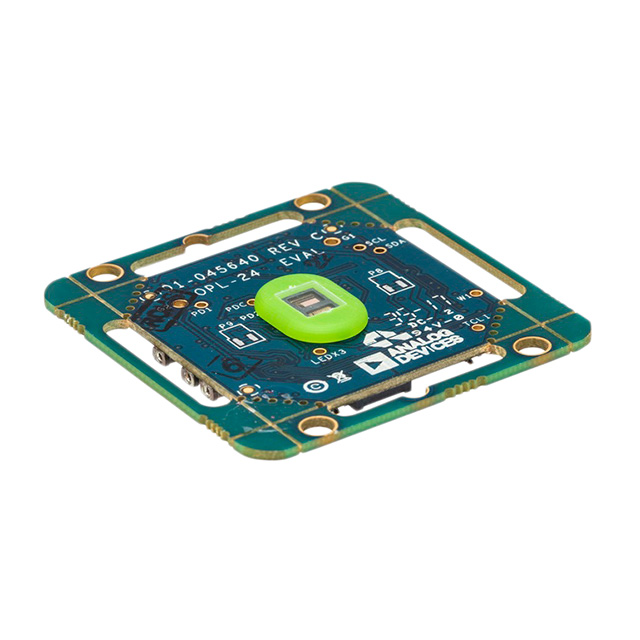
• Integrated Optical Module (3.8mm x 5mm x 0.9mm with 1 blue LED, 1 IR LED and 2 Photo diodes)simplifies EMC design,allows for greater diversity of industrial design options andresults in 75% fewer discrete components.
• simplifies EMC design,
• allows for greater diversity of industrial design options and
• results in 75% fewer discrete components.
• Loop calibration at final test reduces calibration challenges with smoke detector products.
• Supported by ADI designed smoke chamber manufactured by Accumold, 28800X. (Please seeEVAL-CHAMBER Mechanical Dimensions (PDF), also under Resources below)
Description
AI
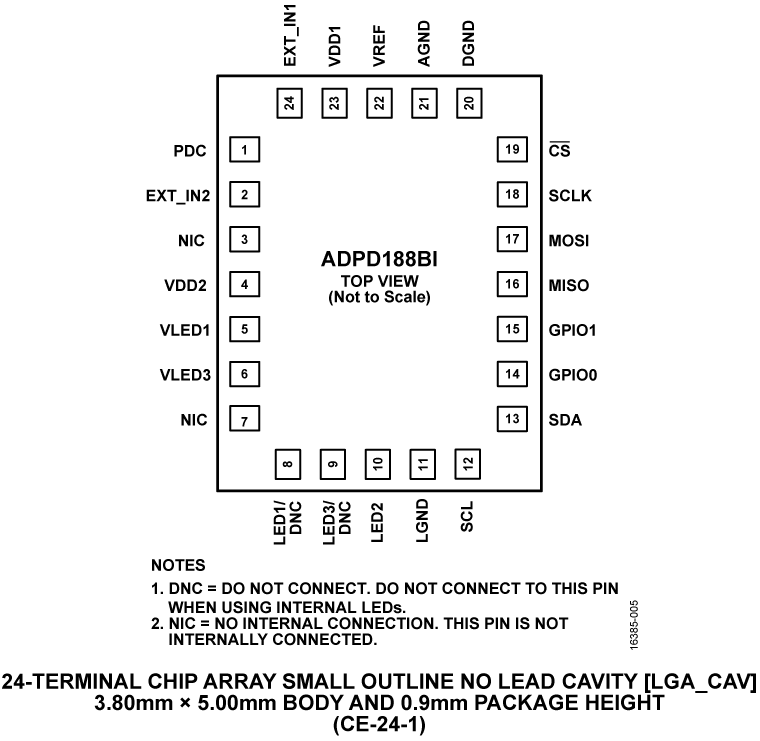
The ADPD188GG is a complete photometric system designed to measure optical signals from ambient light and from synchronous reflected light emitting diode (LED) pulses. Synchronous measurement offers best-in-class rejection of ambient light interference, both dc and ac. The module integrates a highly efficient photometric front end, two LEDs, and two photodiode (PD). All of these items are housed in a custom package that prevents light from going directly from the LED to the photodiode without first entering the subject.The front end of the application specific integrated circuit (ASIC) consists of a control block, a 14-bit analog-to-digital converter (ADC) with a 20-bit burst accumulator, and three flexible, independently configurable LED drivers. The control circuitry includes flexible LED signaling and synchronous detection. The analog front end (AFE) features best-in-class rejection of signal offset and corruption due to modulated interference commonly caused by ambient light. The data output and functional configuration occur over a 1.8 V I2C interface or a serial peripheral interface (SPI) port.ApplicationsOptical heart rate monitoringReflective PPG measurementCNIBP measurement