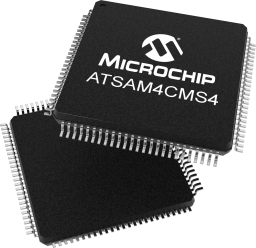
ATSAM4CMP32 Series
Manufacturer: Microchip Technology
Catalog
Key Features
• * ARM Cortex-M4 running at up to 120MHz
• * Memory Protection Unit (MPU)
• * DSP Instruction
• * Thumb®-2 instruction set
• * Instruction and Data Cache Controller with 2 Kbytes Cache Memory
• * 1024Kbytes of flash, 128Kbytes of SRAM, 8Kbytes of ROM
• * ARM Cortex-M4F
• * IEEE 754 Compliant, Single precision Floating-Point Unit (FPU)
• * DSP Instruction
• * Thumb-2 instruction set
• * Instruction and Data Cache Controller with 2 Kbytes Cache Memory
• * 16K+8K bytes of SRAM
• * Interrupt-based Inter-processor Communication
• * Asynchronous Clocking
• * One Interrupt Controller (NVIC) for each core
• * Each Peripheral IRQs routed to each NVIC Inputs
• * High performance AES 128 to 256 with various modes (GCM, CBC, ECB, CFB, CBC-MAC, CTR)
• * TRNG (up to 38 Mbit/s stream, with tested Diehard and FIPS)
• * Public Key Crypto accelerator and associated ROM library for RSA, ECC, DSA, ECDSA
• * Meter Type
• * Integrity Check Module (ICM) based on Secure Hash Algorithm (SHA1, SHA224, SHA256), DMA assisted
• * Two physical Anti-tamper Detection I/Os with Time Stamping and Immediate Clear of General Backup Registers
• * Security Bit for Device Protection from JTAG Accesses
• * Embedded Core and LCD Voltage Regulator for single supply operation
• * Power-on-Reset (POR), Brownout Detector (BOD) and Dual Watchdog for safe operation
• * Ultra-low-power Backup mode (< 0.5 µA Typical @ 25ºC)
• * Optional 3 to 20 MHz quartz or ceramic resonator oscillators with clock failure detection
• * Ultra-low-power 32.768 kHz crystal oscillator for RTC with frequency monitoring
• * High-precision 4/8/12 MHz factory-trimmed internal RC oscillator with on-the-fly trimming capability
• * One high-frequency PLL up to 240 MHz, one 8 MHz PLL with internal 32 kHz input
• * Low-power slow clock internal RC oscillator as permanent clock
• * Ultra-low-power RTC with Gregorian and Persian Calendar, Waveform Generation and Clock Calibration
• * Up to 23 Peripheral DMA (PDC) Channels
• * Display capacity of 38 segments and 6 common terminals
• * Software-selectable LCD output voltage (Contrast)
• * Can be used in Backup mode
• * Four USARTs with ISO7816, IrDA®, RS-485, SPI and Manchester Mode
• * Two 2-wire UARTs
• * Up to two 400 kHz Master/Slave and Multi-Master Two-wire Interfaces (I2C compatible)
• * Up to five Serial Peripheral Interfaces (SPI)
• * Two 3-channel 16-bit Timer/Counters with Capture, Waveform, Compare and PWM modes
• * Quadrature Decoder Logic and 2-bit Gray Up/Down Counter for Stepper Motor
• * 3-channel 16-bit Pulse Width Modulator
• * 32-bit Real-time Timer
• * Works with Microchip's s MCU Metrology library
• * Compliant with Class 0.2 standards (ANSI C12.20-2002 and IEC 62053-22)
• * Four Sigma-Delta ADC measurement channels, 20-bit resolution, 102 dB dynamic range
• * 6-channel, 500 kS/s, Low-power, 10-bit SAR ADC with Digital averager providing 12-bit resolution at 30 kS/s
• * Software Controlled On-chip Reference ranging from 1.6V to 3.4V
• * Temperature Sensor and Backup Battery Voltage Measurement Channel
• * Up to 57 I/O lines with External Interrupt Capability (edge or level sensitivity), Schmitt Trigger, Internal Pull-up/pull-down, Debouncing, Glitch Filtering and On-die Series Resistor Termination
• * Pull-up/pull-down, Debouncing, Glitch Filtering and On-die Series Resistor Termination
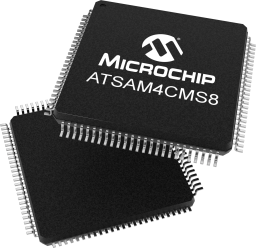
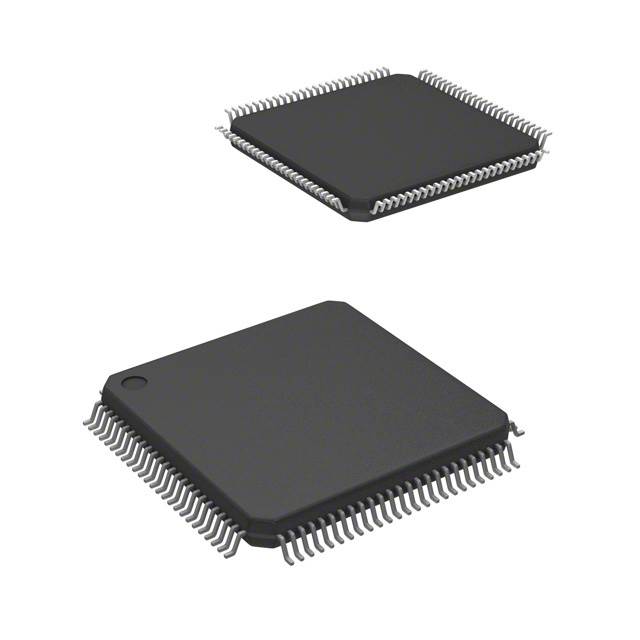
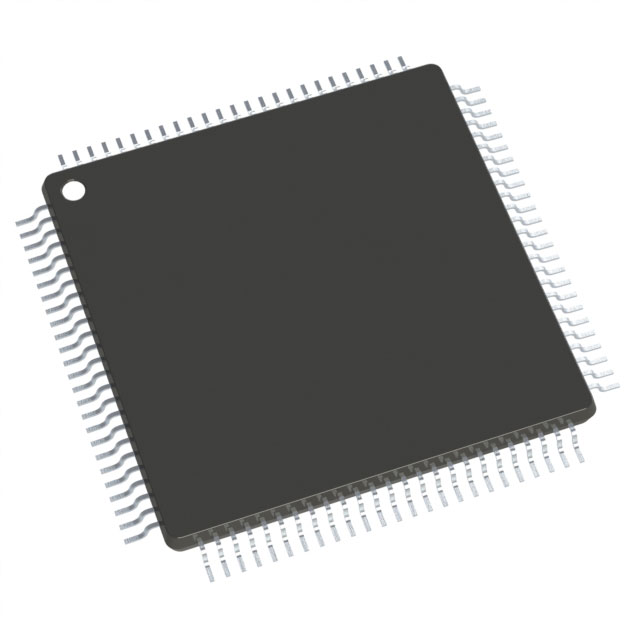
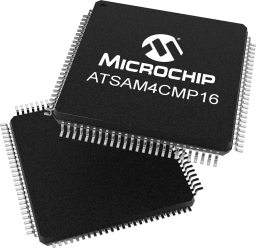
• * 100-lead LQFP, 14 x 14 mm, pitch 0.5 mm
Description
AI
The Microchip's SAM4CMS16 is a system-on-chip solution for residential and single-phase metering applications up to class 0.2 metrology accuracy over a dynamic range of 3000:1 and industrial temperature range. A seamless extension of Atmel's SAM4 family and SAM4C family of microcontrollers and solutions for smart grid security and communications applications, this metrology enabled device offer an unprecedented level of integration and flexibility with dual 32-bit ARM®Cortex®-M4 RISC processors providing maximum speed of 120 MHz each, 1024Kbytes of embedded Flash, 152 Kbytes of SRAM and on-chip cache.
The unique dual ARM Cortex-M4 architecture supports implementation of signal processing, application and communications firmware in independent partitions and offers an ability to extend program and data memory via parallel external bus interface (EBI) to ensure scalability of the design to meet future requirements.