


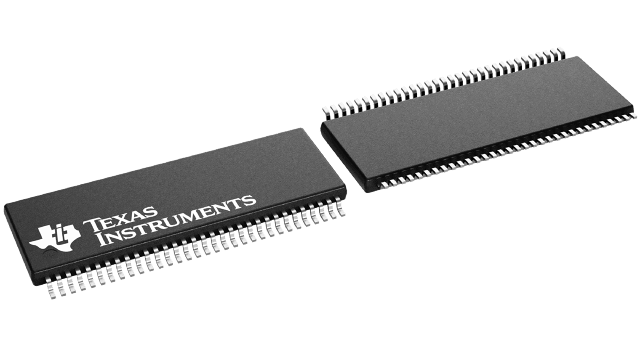
SN74ALVCH16901 Series
18-bit universal bus transceiver with parity generators/checkers
Manufacturer: Texas Instruments
Catalog
18-bit universal bus transceiver with parity generators/checkers
Key Features
• Member of the Texas Instruments Widebus+™ FamilyUBT™ Transceiver Combines D-Type Latches and D-Type Flip-Flops for Operation in Transparent, Latched, or Clocked ModeOperates From 1.65 V to 3.6 VMax tpdof 4.4 ns at 3.3 V±24-mA Output Drive at 3.3 VSimultaneously Generates and Checks ParityOption to Select Generate Parity and Check or Feed-Through Data/Parity in A-to-B or B-to-A DirectionsBus Hold on Data Inputs Eliminates the Need for External Pullup/Pulldown ResistorsLatch-Up Performance Exceeds 250 mA Per JESD 17ESD Protection Exceeds JESD 222000-V Human-Body Model (A114-A)200-V Machine Model (A115-A)Widebus+ and UBT are trademarks of Texas Instruments Incorporated.Member of the Texas Instruments Widebus+™ FamilyUBT™ Transceiver Combines D-Type Latches and D-Type Flip-Flops for Operation in Transparent, Latched, or Clocked ModeOperates From 1.65 V to 3.6 VMax tpdof 4.4 ns at 3.3 V±24-mA Output Drive at 3.3 VSimultaneously Generates and Checks ParityOption to Select Generate Parity and Check or Feed-Through Data/Parity in A-to-B or B-to-A DirectionsBus Hold on Data Inputs Eliminates the Need for External Pullup/Pulldown ResistorsLatch-Up Performance Exceeds 250 mA Per JESD 17ESD Protection Exceeds JESD 222000-V Human-Body Model (A114-A)200-V Machine Model (A115-A)Widebus+ and UBT are trademarks of Texas Instruments Incorporated.
Description
AI
This 18-bit (dual-octal) noninverting registered transceiver is designed for 1.65-V to 3.6-V VCCoperation.
The SN74ALVCH16901 is a dual 9-bit to dual 9-bit parity transceiver with registers. The device can operate as a feed-through transceiver or it can generate/check parity from the two 8-bit data buses in either direction.
The SN74ALVCH16901 features independent clock (CLKAB or CLKBA), latch-enable (LEAB or LEBA), and dual 9-bit clock-enable (CLKENAB\ or CLKENBA\) inputs. It also provides parity-enable (SEL\) and parity-select (ODD/EVEN\) inputs and separate error-signal (ERRA\ or ERRB\) outputs for checking parity. The direction of data flow is controlled by OEAB\ and OEBA\. When SEL\ is low, the parity functions are enabled. When SEL\ is high, the parity functions are disabled and the device acts as an 18-bit registered transceiver.
To ensure the high-impedance state during power up or power down, OE\ should be tied to VCCthrough a pullup resistor; the minimum value of the resistor is determined by the current-sinking capability of the driver.
The A and B I/Os and APAR and BPAR inputs have bus-hold circuitry. Active bus-hold circuitry holds unused or undriven data inputs at a valid logic state. Use of pullup or pulldown resistors with the bus-hold circuitry is not recommended.
This 18-bit (dual-octal) noninverting registered transceiver is designed for 1.65-V to 3.6-V VCCoperation.
The SN74ALVCH16901 is a dual 9-bit to dual 9-bit parity transceiver with registers. The device can operate as a feed-through transceiver or it can generate/check parity from the two 8-bit data buses in either direction.
The SN74ALVCH16901 features independent clock (CLKAB or CLKBA), latch-enable (LEAB or LEBA), and dual 9-bit clock-enable (CLKENAB\ or CLKENBA\) inputs. It also provides parity-enable (SEL\) and parity-select (ODD/EVEN\) inputs and separate error-signal (ERRA\ or ERRB\) outputs for checking parity. The direction of data flow is controlled by OEAB\ and OEBA\. When SEL\ is low, the parity functions are enabled. When SEL\ is high, the parity functions are disabled and the device acts as an 18-bit registered transceiver.
To ensure the high-impedance state during power up or power down, OE\ should be tied to VCCthrough a pullup resistor; the minimum value of the resistor is determined by the current-sinking capability of the driver.
The A and B I/Os and APAR and BPAR inputs have bus-hold circuitry. Active bus-hold circuitry holds unused or undriven data inputs at a valid logic state. Use of pullup or pulldown resistors with the bus-hold circuitry is not recommended.