Catalog
5.6 GHz to 8.6 GHz, GaAs, MMIC, I/Q Downconverter
Key Features
• Conversion gain: 13 dB typical
• Image rejection: 32 dBc typical
• Input P1dB compression: −6 dBm typical
• Input IP3: 3 dBm typical, 6.0 GHz to 8.6 GHz
• Noise figure: 2 dB typical
• LO to RF isolation: 48 dBm typical
• LO to IF isolation: 13 dBm typical
• RF to IF isolation: 10 dBm typical
• Amplitude balance: 0.2 dB typical
• Phase balance: −2° typical
• RF return loss: 10 dB typical
• LO return loss: 15 dB typical
• IF return loss: 15 dB typical
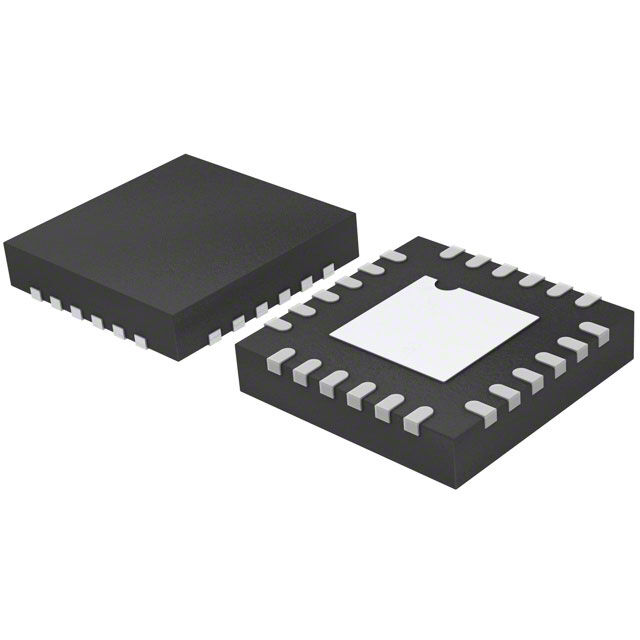
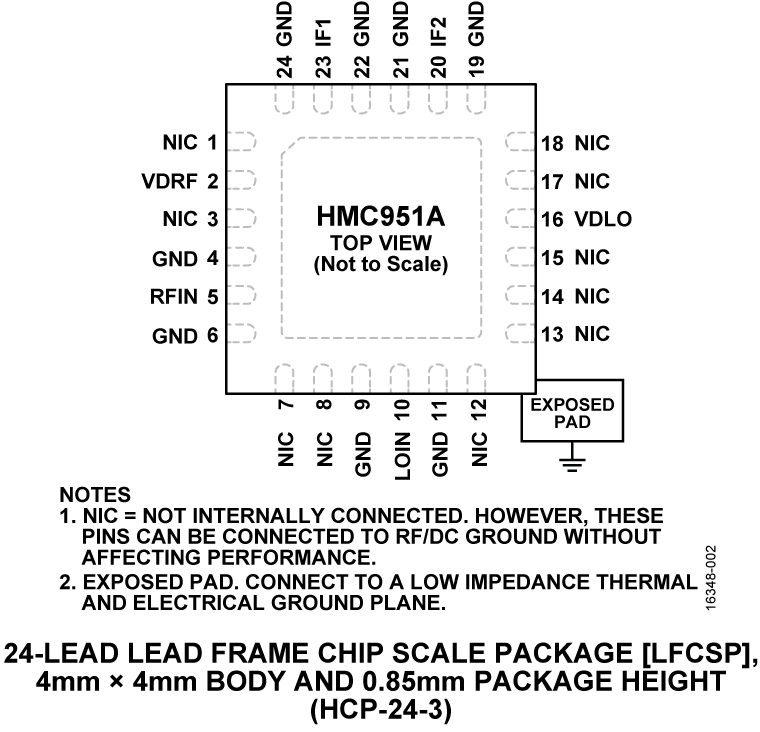
• Exposed paddle, 4 mm × 4 mm, 24-lead, LFCSP
Description
AI
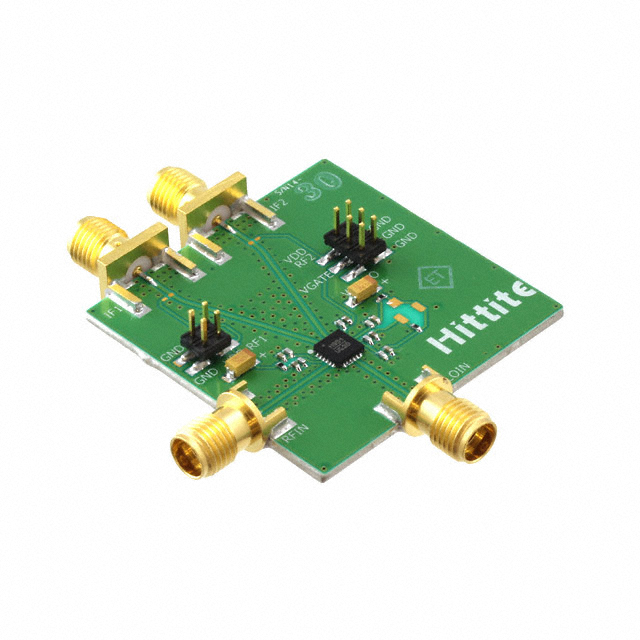
The HMC951A is a compact gallium arsenide (GaAs), monolithic microwave integrated circuit (MMIC), in-phase quadrature (I/Q) downconverter in a RoHS compliant package that operates from 5.6 GHz to 8.6 GHz. This device provides a small signal conversion gain of 13 dB with a noise figure of 2 dB and an image rejection of 32 dBc. The HMC951A uses a low noise amplifier (LNA) followed by an image mixer that is driven by a local oscillator (LO) buffer amplifier. The image reject mixer eliminates the need for a filter following the LNA and removes thermal noise at the image frequency. The IF1 and IF2 mixer outputs are provided and an external 90° hybrid is needed to select the required sideband. The I/Q mixer topology reduces the need for filtering of unwanted sideband. The HMC951A is a smaller alternative to hybrid style, single sideband (SSB) downconverter assemblies, and it eliminates the need for wire bonding by allowing the use of surface-mount manufacturing techniques.The HMC951A is available in 4 mm × 4 mm, 24-lead lead frame chip scale package (LFCSP) and operates over the −40°C to +85°C temperature range. An evaluation board for the HMC951A is also available upon request.ApplicationsPoint to point and point to multipoint radiosMilitary radars, electronic warfare, and electronic intelligenceSatellite communicationsSensors