


Catalog
32-Position Manual Up/Down Control Potentiometer
Key Features
• 32-position digital potentiometer
• 10 kΩ, 50 kΩ, 100 kΩend-to-end terminal resistance
• Simple manual up/down control
• Self-contained, requires only 2 pushbutton tactile switches
• Built-in adaptive debouncer
• Autoscan up/down control with 4 steps per second
• Pin-selectable zero-scale/midscale preset
• Low potentiometer mode tempco, 5 ppm/°C
• Low rheostat mode tempco, 35 ppm/°C
• Digital control compatible
• Ultralow power, IDD = 0.4 μA typ and 3 μA max
• See data sheet for additional features
Description
AI
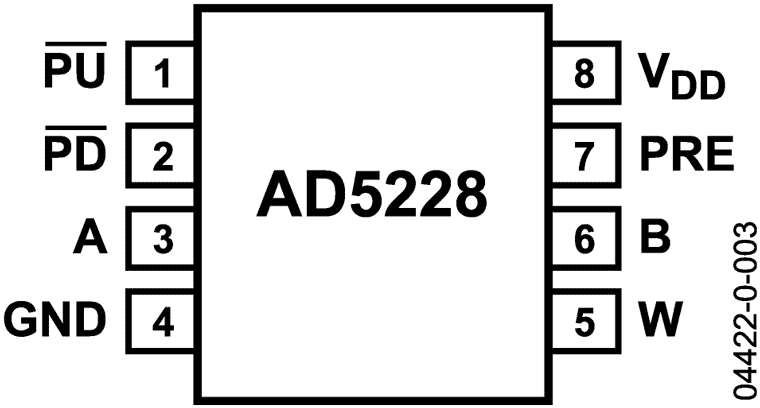
The AD5228 is Analog Devices’ latest 32-step-up/step-down control digital potentiometer emulating mechanical potentiometer operation. Its simple up/down control interface allows manual control with just two external pushbutton tactile switches. The AD5228 is designed with a built-in adaptive debouncer that ignores invalid bounces due to contact bounce commonly found in mechanical switches. The debouncer is adaptive, accommodating a variety of pushbutton tactile switches that generally have less than 10 ms of bounce time during contact closures. When choosing the switch, the user should consult the timing specification of the switch to ensure its suitability in an AD5228 application.The AD5228 can increment or decrement the resistance in discrete steps or in autoscan mode. When thePUorPDbutton is pressed briefly (no longer than 0.6 s), the resistance of the AD5228 changes by one step. When thePUorPDbutton is held continuously for more than a second, the device activates the autoscan mode and changes four resistance steps per second.The AD5228 can also be controlled digitally; its up/down features simplify microcontroller usage. The AD5228 is available in a compact thin SOT-23-8 (TSOT-8) package. The part is guaranteed to operate over the automotive temperature range of −40°C to +105°C.The AD5228’s simple interface, small footprint, and very low cost enable it to replace mechanical potentiometers and trimmers with typically 3× improved resolution, solid-state reliability, and faster adjustment, resulting in considerable cost saving in end users’ systems.Users who consider EEMEM potentiometers should refer to the recommendations in the Applications section.APPLICATIONSMechanical potentiometer and trimmer replacementsLCD backlight, contrast, and brightness controlsDigital volume controlPortable device-level adjustmentsElectronic front panel-level controlsProgrammable power supply
