Catalog
16-Bit, 1600 MSPS, TxDAC+ Digital-to-Analog Converter
Key Features
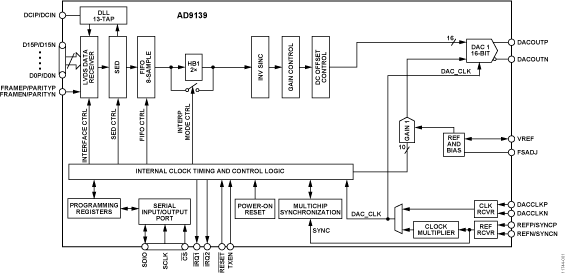
• Selectable 1×, 2× interpolation filterSupport input signal bandwidth up to 575 MHz
• Support input signal bandwidth up to 575 MHz
• Very small inherent latency variation: <2 DAC clock cycles
• Proprietary low spurious and distortion design6-carrier GSM ACLR = 79 dBc at 200 MHz IFSFDR >85 dBc (bandwidth = 300 MHz) at zero IF
• 6-carrier GSM ACLR = 79 dBc at 200 MHz IF
• SFDR >85 dBc (bandwidth = 300 MHz) at zero IF
• Flexible 16-bit LVDS interfaceSupports word and byte load
• Supports word and byte load
• Multiple chip synchronizationFixed latency and data generator latency compensation
• Fixed latency and data generator latency compensation
• FIFO eases system timing and includes error detection
• High performance, low noise PLL clock multiplier
• Digital inverse sinc filter
• Low power: 700 mW at 1230 MSPS
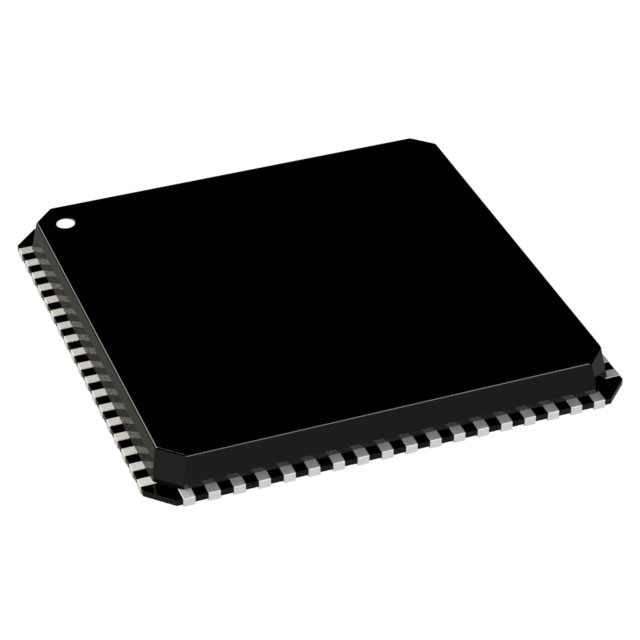
• 72-lead LFCSP
Description
AI
The AD9139 is a 16-bit, high dynamic range digital-to-analog converter (DAC) that provides a maximum update rate of 1600 MSPS, permitting multicarrier generation up to the Nyquist frequency. The AD9139 TxDAC+®includes features optimized for wide band communications applications, including 1× and 2× interpolation, a DLL based high speed interface, sample error detection, and parity detection. A 3-wire serial port interface provides for the programming/readback of many internal parameters. Full-scale output current can be programmed over a range of 9 mA up to 33 mA. The AD9139 is available in a 72-lead LFCSP.Product Highlights575 MHz achievable input signal bandwidth.Advanced low spurious and distortion design techniques provide high quality synthesis of wideband signals from baseband to high intermediate frequencies.Very small inherent latency variation simplifies both software and hardware design in the system. It allows easy multichip synchronization for most applications.Low power architecture improves power efficiency.ApplicationsWireless communications: 3G/4G and MC-GSM base stations, wideband repeaters, software defined radiosWideband communications: point-to-point, LMDS/MMDSTransmit diversity/MIMOInstrumentationAutomated test equipment