ATSAM4LC4A Series
Manufacturer: Microchip Technology
Catalog
Key Features
• * ARM Cortex-M4 running at up to 48 MHz
• * Memory Protection Unit (MPU)
• * DSP Instructions, Thumb®-2 instruction set
• * 128 Kbytes embedded Flash, 0 wait-state capability up to 24MHz
• * 32 Kbytes embedded SRAM
• * Embedded voltage regulator for single-supply operation
• * Two Power-on-Reset and Two Brown-out Detectors (BOD)
• * Quartz or ceramic resonator oscillators: 0.6 to 30MHz main power with Failure Detection and low power 32.768 kHz for RTC or device clock
• * High-precision 8/12 MHz factory-trimmed internal RC oscillator
• * Slow clock internal RC oscillator as permanent low-power mode device clock
• * High speed 80MHz internal RC oscillator
• * Low power 32kHz internal RC oscillator
• * PLL up to 240MHz for device clock and for USB
• * Digital Frequency Locked Loop (DFLL) with wide input range
• * Up to 16 peripheral DMA (PDCA) channels
• * Active mode down to 90μA/MHz with configurable voltage scaling
• * High performance and efficiency: 28 coremark/mA
• * Wait mode down to 3μA with fast wake-up time (<1.5μs) supporting SleepWalking
• * Full RAM and Logic Retention mode down to 1.5μA with fast wake-up time (<1.5μs)
• * Ultra low power Backup mode with/without RTC down to 1.5/0.9μA
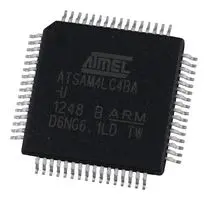
• * 64-lead LQFP, 10x10 mm, pitch 0.5 mm
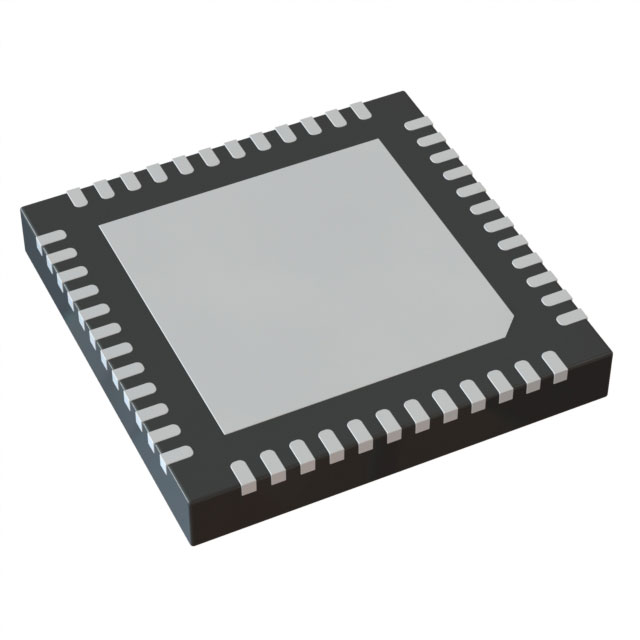
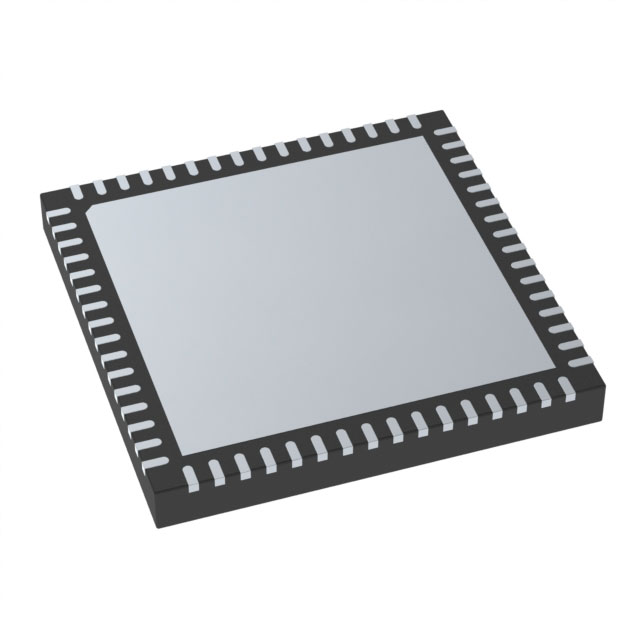
• * 64-pad QFN, 9x9 mm, pitch 0.5 mm
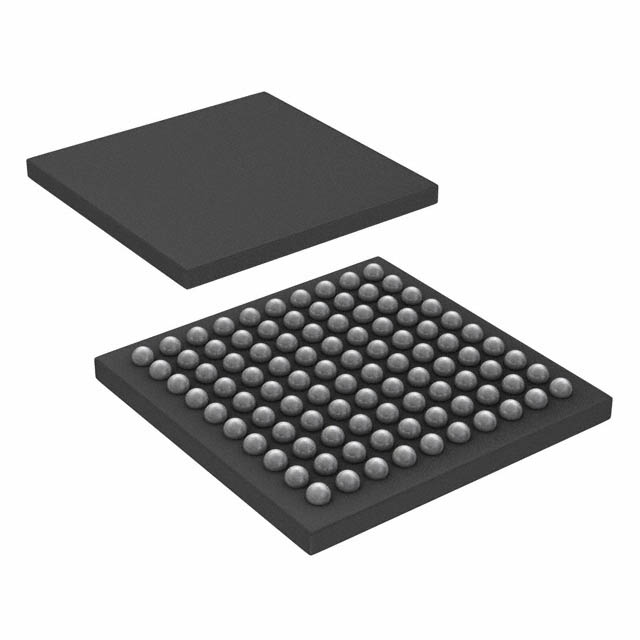
• * 64-ball WLCSP, 5,270x5,194 mm, pitch 0.5 mm
• * Industrial (-40° C to +85° C)
• * USB 2.0 Device and Embedded Host: 12 Mbps, up to 8 bidirectional Endpoints and Multi-packet Ping-pong Mode. On-Chip Transceiver
• * One USART with ISO7816, IrDA®, RS-485, SPI, Manchester and LIN Mode
• * Three USART with SPI Mode
• * One PicoUART for extended UART wake-up capabilities in all sleep modes
• * Liquid Crystal Display (LCD) Module with Capacity up to 40 Segments and up to 4 Common Terminals
• * Windowed Watchdog Timer (WDT)
• * Asynchronous Timer (AST) with Real-time Clock Capability, Counter or Calendar Mode Supported
• * Frequency Meter (FREQM) for Accurate Measuring of Clock Frequency
• * Three 16-bit Timer/Counter (TC) Channels with capture, waveform, compare and PWM mode
• * One Master/Slave Serial Peripheral Interface (SPI) with Chip Select Signals
• * Four Master and Two Slave Two-wire Interfaces (TWI), up to 3.4Mbit/s I2C-compatible
• * Capacitive Touch Module (CATB) supporting up to 32 buttons
• * Inter-IC Sound (IISC) Controller, Compliant with Inter-IC Sound (I2S) Specification
• * Peripheral Event System for Direct Peripheral to Peripheral Communication
• * Parallel Capture Module (PARC)
• * Glue Logic Controller (GLOC)
• * 43 I/O lines with external interrupt capability (edge or level sensitivity), debouncing, glitch filtering and slew-rate control
• * Three High-drive I/O Pins
• * One 8-channel ADC 300Ksps (ADC) with up to 12 Bits Resolution
• * One DAC 500Ksps (DACC) with up to 10 Bits Resolution
• * Two Analog Comparators (ACIFC) with Optional Window Detection
• * Audio Bitstream DAC (ABDACB) Suitable for Stereo Audio
• * One Advanced Encryption System (AES) with 128-bit key length
• * 32-bit Cyclic Redundancy Check Calculation Unit (CRCCU)
• * Random generator (TRNG)
• * Serial Wire/JTAG Debug Port(SWJ-DP)
• * Debug access to all memories and registers in the system, including Cortex-M4 register bank when the core is running, halted, or held in reset.
• * Serial Wire Debug Port (SW-DP) and Serial Wire JTAG Debug Port (SWJ-DP) debug access.
• * Flash Patch and Breakpoint (FPB) unit for implementing breakpoints and code patches.
• * Data Watchpoint and Trace (DWT) unit for implementing watchpoints, data tracing, and system profiling.
• * Instrumentation Trace Macrocell (ITM) for support of printf style debugging.
• * IEEE1149.1 JTAG Boundary-scan on all digital pins.
• * ASF-Atmel software Framework – SAM software development framework
• * Integrated in the Atmel Studio IDE with a graphical user interface or available as standalone for GCC, IAR compilers.
• * DMA support, Interrupt handlers Driver support
• * USB, TCP/IP, Wi-Fi and Bluetooth, Numerous USB classes, DHCP and Wi-Fi encryption Stacks
• * RTOS integration, FreeRTOS is a core component
Description
AI
A member of the Microchip's SAM4L family of flash microcontrollers based on the ARM® Cortex®-M4 processor, the ATSAM4LC4A delivers the lowest power in active mode (90uA/MHz) as well as sleep mode (1.5uA) and the shortest wake-up time (down to 1.5us) in a Cortex-M4-based device.
Along with 256KB of embedded flash memory, the device features an LCD controller, hardware cryptography, USB host and device, peripheral event system, SleepWalking intelligent peripherals, and built-in security, including 128-bit Advanced Encryption Standard (AES).
Integrated Microchip QTouch technology makes it easy to bring capacitive touch functionality to your hardware.