Catalog
Tactical Grade, Six Degrees of Freedom Inertial Sensor
Key Features
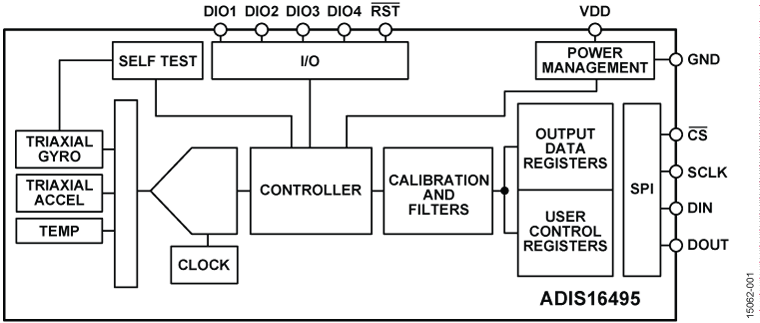
• Triaxial, digital gyroscope±125°/sec, ±450°/sec, ±2000°/sec range options±0.05° axis to axis misalignment error±0.25° (maximum) axis to package misalignment error0.8°/hr in-run bias stability (ADIS16495-1)0.09°/√hr angular random walk (ADIS16495-1)
• ±125°/sec, ±450°/sec, ±2000°/sec range options
• ±0.05° axis to axis misalignment error
• ±0.25° (maximum) axis to package misalignment error
• 0.8°/hr in-run bias stability (ADIS16495-1)
• 0.09°/√hr angular random walk (ADIS16495-1)
• Triaxial, digital accelerometer, ±8g3.2 μgin run bias stability
• 3.2 μgin run bias stability
• Triaxial, delta angle and delta velocity outputs
• Factory calibrated sensitivity, bias, and axial alignmentCalibration temperature range: −40°C to +85°C
• Calibration temperature range: −40°C to +85°C
• SPI compatible
• Programmable operation and controlAutomatic and manual bias correction controlsConfigurable FIR filtersDigital I/O: data ready, external clockSample clock options: internal, external, or scaledOn demand self test of inertial sensors
• Automatic and manual bias correction controls
• Configurable FIR filters
• Digital I/O: data ready, external clock
• Sample clock options: internal, external, or scaled
• On demand self test of inertial sensors
• Single-supply operation: 3.0 V to 3.6 V
• 1500gmechanical shock survivability
• Operating temperature range: −40°C to +105°C
Description
AI
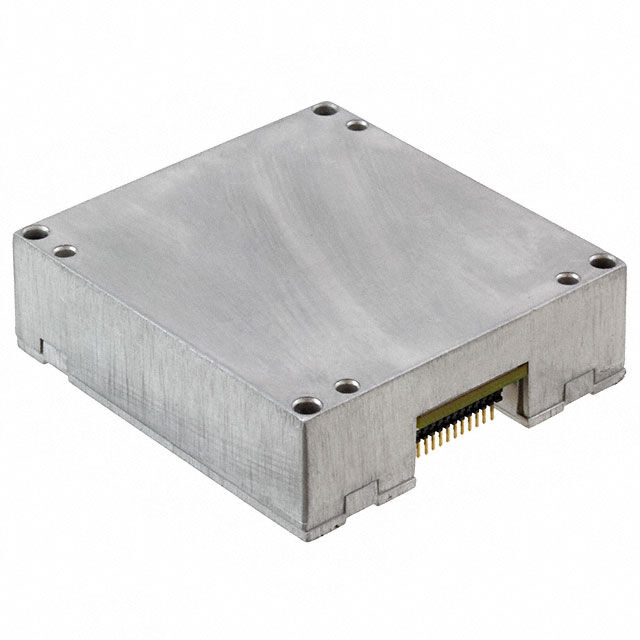
The ADIS16495 is a complete inertial system that includes a triaxis gyroscope and a triaxis accelerometer. Each inertial sensor in the ADIS16495 combines industry leadingiMEMS®technology with signal conditioning that optimizes dynamic performance. The factory calibration characterizes each sensor for sensitivity, bias, alignment, and linear acceleration (gyroscope bias). As a result, each sensor has its own dynamic compensation formulas that provide accurate sensor measurements.The ADIS16495 provides a simple, cost effective method for integrating accurate, multiaxis inertial sensing into industrial systems, especially when compared with the complexity and investment associated with discrete designs. All necessary motion testing and calibration are part of the production process at the factory, greatly reducing system integration time. Tight orthogonal alignment simplifies inertial frame alignment in navigation systems. The serial peripheral interface (SPI) and register structure provide a simple interface for data collection and configuration control.The footprint and connector system of the ADIS16495 enable a simple upgrade from the ADIS16375, ADIS16480, ADIS16485, ADIS16488A, and ADIS16490. The ADIS16495 is available in an aluminum package that is approximately 47 mm × 44 mm × 14 mm and includes a standard connector interface.ApplicationsPrecision instrumentation, stabilizationGuidance, navigation, controlAvionics, unmanned vehiclesPrecision autonomous machines, robotics