


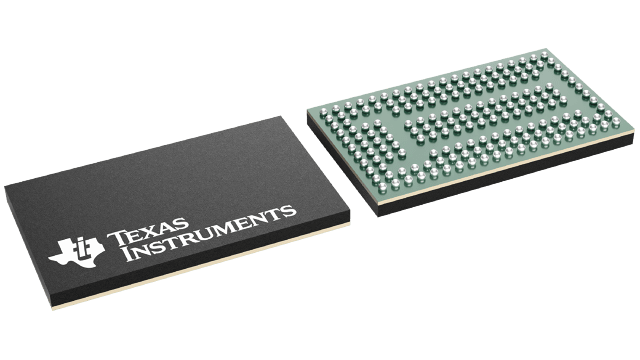
SN74SSQEA32882 Series
810-MHz, JEDEC SSTE32882 compliant 28-bit to 56-bit registered buffer with address-parity test
Manufacturer: Texas Instruments
Catalog
810-MHz, JEDEC SSTE32882 compliant 28-bit to 56-bit registered buffer with address-parity test
Key Features
• JEDEC SSTE32882 Compliant1-to-2 Register Outputs and 1-to-4 Clock Pair Outputs SupportStacked DDR3 RDIMMsCKE Powerdown Mode for Optimized System Power Consumption1.5V/1.35V Phase Lock Loop Clock Driver for Buffering OneDifferential Clock Pair (CK andCK) and Distributingto Four Differential Outputs1.5V/1.35V CMOS InputsChecks Parity on Command and Address (CS-Gated) Data InputsConfigurable Driver StrengthUses Internal Feedback LoopAPPLICATIONSDDR3 Registered DIMMs up to DDR3-1600DDR3L Registered DIMMs up to DDR3L-1333Single-, Dual- and Quad-Rank RDIMMJEDEC SSTE32882 Compliant1-to-2 Register Outputs and 1-to-4 Clock Pair Outputs SupportStacked DDR3 RDIMMsCKE Powerdown Mode for Optimized System Power Consumption1.5V/1.35V Phase Lock Loop Clock Driver for Buffering OneDifferential Clock Pair (CK andCK) and Distributingto Four Differential Outputs1.5V/1.35V CMOS InputsChecks Parity on Command and Address (CS-Gated) Data InputsConfigurable Driver StrengthUses Internal Feedback LoopAPPLICATIONSDDR3 Registered DIMMs up to DDR3-1600DDR3L Registered DIMMs up to DDR3L-1333Single-, Dual- and Quad-Rank RDIMM
Description
AI
This JEDEC SSTE32882-compliant, 28-bit 1:2 or 26-bit 1:2 and 4-bit 1:1 registering clock driver with parity is designed for operation on DDR3 registered DIMMs with VDDof 1.5 V and on DDR3L registered DIMMs with VDDof 1.35 V.
All inputs are 1.5 V and 1.35 V CMOS compatible. All outputs are CMOS drivers optimized to drive DRAM signals on terminated traces in DDR3 RDIMM applications. The clock outputs Yn andYnand control net outputs DxCKEn,DxCSnand DxODTn can be driven with a different strength and skew to optimize signal integrity, compensate for different loading and equalize signal travel speed.
The SN74SSQEA32882 has two basic modes of operation associated with the Quad Chip Select Enable (QCSEN) input. When theQCSENinput pin is open (or pulled high), the component has two chip select inputs,DCS0andDCS1, and two copies of each chip select output,QACS0,QACS1,QBCS0andQBCS1. This is the "QuadCS disabled" mode. When theQCSENinput pin is pulled low, the component has four chip select inputsDCS[3:0], and four chip select outputs,QCS[3:0]. This is the "QuadCS enabled" mode. Through the remainder of this specification,DCS[n:0]will indicate all of the chip select inputs, where n=1 for QuadCS disabled, and n=3 for QuadCS enabled.QxCS[n:0]will indicate all of the chip select outputs.
The device also supports a mode where a single device can be mounted on the back side of a DIMM. If MIRROR=HIGH, Input Bus Termination (IBT) has to stay enabled for all input signals in this case.
The SN74SSQEA32882 operates from a differential clock (CK andCK). Data are registered at the crossing of CK going HIGH, andCKgoing LOW. This data could be either re-driven to the outputs or it could be used to access device internal control registers.
The input bus data integrity is protected by a parity function. All address and command input signals are added up and the last bit of the sum is compared to the parity signal delivered by the system at the input PAR_IN one clock cycle later. If they do not match the device pulls the open drain outputERROUTLOW. The control signals (DCKE0, DCKE1, DODT0, DODT1,DCS[n:0]) are not part of this computation.
The SN74SSQEA32882 implements different power saving mechanisms to reduce thermal power dissipation and to support system power down states. By disabling unused outputs the power consumption is further reduced.
The package is optimized to support high density DIMMs. By aligning input and output positions towards DIMM finger signal ordering and SDRAM ballout the device de-scrambles the DIMM traces allowing low cross talk design with low interconnect latency.
Edge controlled outputs reduce ringing and improve signal eye opening at the SDRAM inputs.
This JEDEC SSTE32882-compliant, 28-bit 1:2 or 26-bit 1:2 and 4-bit 1:1 registering clock driver with parity is designed for operation on DDR3 registered DIMMs with VDDof 1.5 V and on DDR3L registered DIMMs with VDDof 1.35 V.
All inputs are 1.5 V and 1.35 V CMOS compatible. All outputs are CMOS drivers optimized to drive DRAM signals on terminated traces in DDR3 RDIMM applications. The clock outputs Yn andYnand control net outputs DxCKEn,DxCSnand DxODTn can be driven with a different strength and skew to optimize signal integrity, compensate for different loading and equalize signal travel speed.
The SN74SSQEA32882 has two basic modes of operation associated with the Quad Chip Select Enable (QCSEN) input. When theQCSENinput pin is open (or pulled high), the component has two chip select inputs,DCS0andDCS1, and two copies of each chip select output,QACS0,QACS1,QBCS0andQBCS1. This is the "QuadCS disabled" mode. When theQCSENinput pin is pulled low, the component has four chip select inputsDCS[3:0], and four chip select outputs,QCS[3:0]. This is the "QuadCS enabled" mode. Through the remainder of this specification,DCS[n:0]will indicate all of the chip select inputs, where n=1 for QuadCS disabled, and n=3 for QuadCS enabled.QxCS[n:0]will indicate all of the chip select outputs.
The device also supports a mode where a single device can be mounted on the back side of a DIMM. If MIRROR=HIGH, Input Bus Termination (IBT) has to stay enabled for all input signals in this case.
The SN74SSQEA32882 operates from a differential clock (CK andCK). Data are registered at the crossing of CK going HIGH, andCKgoing LOW. This data could be either re-driven to the outputs or it could be used to access device internal control registers.
The input bus data integrity is protected by a parity function. All address and command input signals are added up and the last bit of the sum is compared to the parity signal delivered by the system at the input PAR_IN one clock cycle later. If they do not match the device pulls the open drain outputERROUTLOW. The control signals (DCKE0, DCKE1, DODT0, DODT1,DCS[n:0]) are not part of this computation.
The SN74SSQEA32882 implements different power saving mechanisms to reduce thermal power dissipation and to support system power down states. By disabling unused outputs the power consumption is further reduced.
The package is optimized to support high density DIMMs. By aligning input and output positions towards DIMM finger signal ordering and SDRAM ballout the device de-scrambles the DIMM traces allowing low cross talk design with low interconnect latency.
Edge controlled outputs reduce ringing and improve signal eye opening at the SDRAM inputs.