Catalog
FOM Management IC with Internal Calibration
Key Features
- APC or constant-current laser bias
- Turbo mode for APC loop start-up and shorter laser turn on time
- Supports multiple laser types and bias circuit topologies
- Integrated digital temperature sensor
- Temperature compensation of modulation, bias, and fault levels via NVRAM look-up tables
- NVRAM to support GBIC/SFP serial ID function
- User writable EEPROM scratchpad
- Diagnostic monitoring interface per SFF-8472
- Monitors and reports critical parameters: temperature, bias current, TX and RX optical power, and supply voltage
- S/W control and monitoring of TXFAULT, RXLOS, RATESELECT, and TXDISABLE
- Internal or external calibration
- EEPOT for adjusting RX power measurement
- Power-on hour meter
- Interrupt capability
- Extensive test and calibration features
- 2-wire, I2C-compatible serial interface
- SFP MSA and SFF-8472 compliant
- 3.0V to 3.6V power supply range
- 5V-tolerant I/O
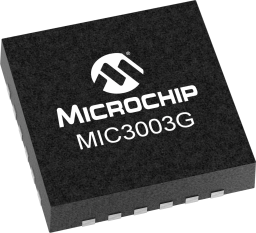
- 4mm x 4mm 24-pin QFN package
Description
AI
**FOM Controller with Internal Calibration**
The MIC3003 enables the implementation of sophisticated, hot-pluggable fiber optic transceivers with intelligent laser control and an internally calibrated digital diagnostic monitoring interface per SFF-8472. It essentially integrates all non-data path functions of an SFP transceiver into a tiny (4mm x 4mm) QFN package. A highly-configurable automatic power control (APC) circuit controls laser bias. Bias and modulation are temperature compensated using dual DACs, an on-chip temperature sensor, and NVRAM look-up tables. A programmable internal feedback resistor provides unprecedented dynamic range for APC. Controlled laser turn-on facilitates hot plugging. An analog-to-digital converter converts the measured temperature, voltage, bias current, transmit power, and received power from analog to digital. An EEPOT provides front-end adjustment of RX power. Each parameter is compared against user-programmed warning and alarm thresholds. Analog comparators and DACs provide high-speed monitoring of received power and critical laser operating parameters. Data can be reported as either internally calibrated or externally calibrated. An interrupt output, power-on hour meter, and data-ready bits add user friendliness beyond SFF-8472. The interrupt output and data-ready bits reduce overhead in the host system. The power-on hour meter logs operating hours using an internal real-time clock and stores the result in NVRAM. In addition to the features listed above which are already implemented in the previous MIC300x controllers, the MIC3003 features an extended temperature range, options
to mask alarms and warnings interrupt and TXFAULT, a reset signal source, and the ability to support up to four chips with the same address on the serial interface. It also supports eight-byte SMBus block writes. Communication with the MIC3003 is via an industry standard 2-wire SMBus serial interface. Nonvolatile memory is provided for serial ID, configuration, and separate OEM and user scratchpad spaces.