ATSAM4E16C Series
Manufacturer: Microchip Technology
Catalog
Key Features
• * ARM Cortex-M4 with 2 Kbytes Cache running at up to 120 MHz
• * Memory Protection Unit (MPU)
• * DSP Instructions, Floating Point Unit (FPU), Thumb®-2 instruction set
• * 512 Kbytes Embedded Flash
• * 128 Kbytes Embedded SRAM
• * 16 Kbytes ROM with Embedded Boot Loader Routines (UART) and IAP Routines
• * Static Memory Controller (SMC): SRAM, NOR, NAND Support
• * NAND Flash Controller
• * External Bus Interface: 8-bit Data, 4 Chip Selects, 24-bit Address
• * Embedded voltage regulator for single-supply operation
• * Power-on-Reset (POR), Brown-out Detector (BOD) and Dual Watchdog for Safe Operation
• * Quartz or ceramic resonator oscillators: 3 to 20 MHz with clock failure detection and 32.768 kHz for RTT or system clock
• * RTC with Gregorian and Persian Calendar Mode, Waveform Generation in Backup mode
• * RTC counter calibration circuitry compensates for 32.768 kHz crystal frequency inaccuracy
• * High-precision 8/16/24 MHz factory-trimmed internal RC oscillator. In-application trimming access for frequency adjustment
• * Slow clock internal RC oscillator as permanent low-power mode device clock
• * One PLL up to 240 MHz for Device Clock and for USB
• * Temperature Sensor
• * Low-power tamper detection on two inputs, anti-tampering by immediate clear of general-purpose backup registers (GPBR)
• * Up to 2 Peripheral DMA Controllers (PDC) with up to 33 Channels
• * One 4-channel DMA Controller
• * Sleep, Wait and Backup modes, down to 0.9 μA in Backup mode with RTC, RTT, and GPBR
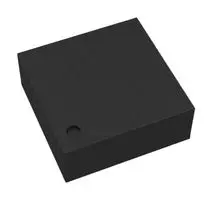
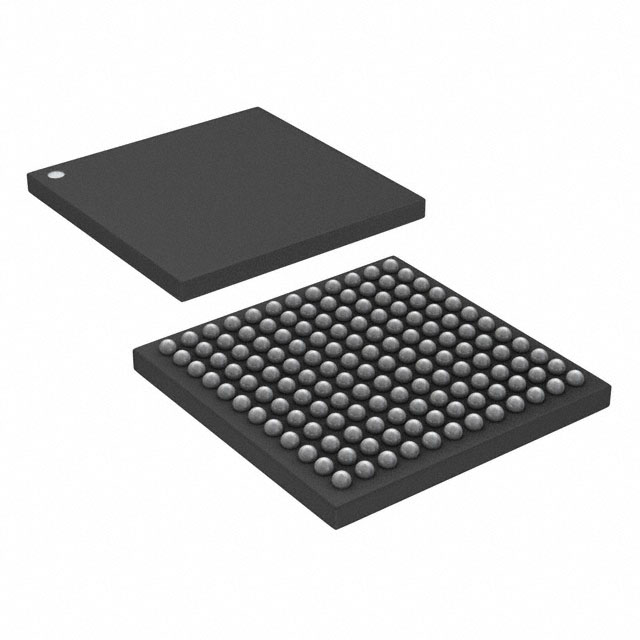
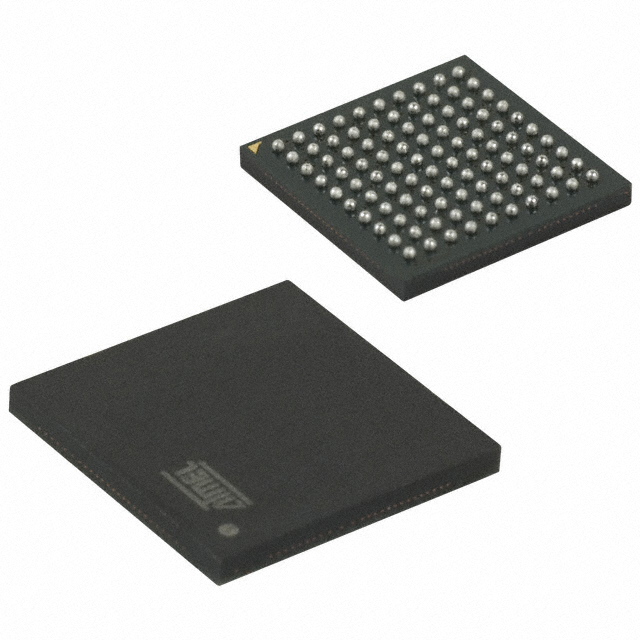
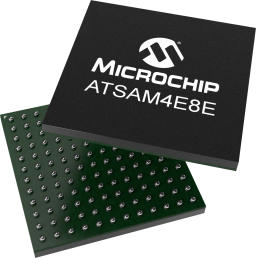
• * 144-ball LFBGA, 10x10 mm, pitch 0.8 mm
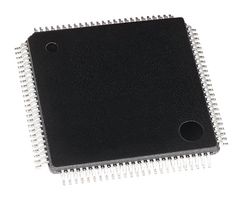
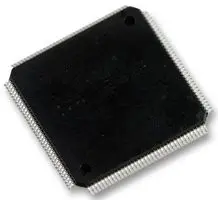
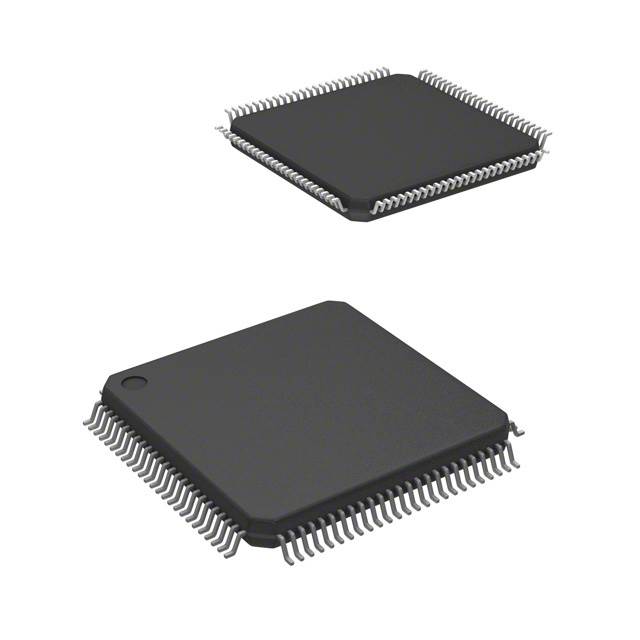
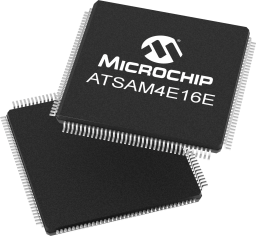
• * 144-lead LQFP, 20x20 mm, pitch 0.5 mm
• * Revision A - Industrial (-40° C to +85° C), Revision B - (-40° C to +105° C)
• * Two USARTs with USART1 (ISO7816, IrDA®, RS-485, SPI, Manchester and Modem Modes)
• * USB 2.0 Device: Full Speed (12 Mbits), 2668 byte FIFO, up to 8 Endpoints. On-chip Transceiver
• * Two 2-wire UARTs
• * Two 2-wire Interfaces (TWI)
• * High-speed Multimedia Card Interface (SDIO/SD Card/MMC)
• * One Master/Slave Serial Peripheral Interface (SPI) with Chip Select Signals
• * Three 3-channel 32-bit Timer/Counter blocks with Capture, Waveform, Compare and PWM Mode. Quadrature Decoder Logic and 2-bit Gray Up/Down Counter for Stepper Motor.
• * 32-bit low-power Real-time Timer (RTT) and low-power Real-time Clock (RTC) with calendar and alarm features
• * 256-bit General Purpose Backup Registers (GPBR)
• * One Ethernet MAC (GMAC) 10/100 Mbps in MII mode only with dedicated DMA and Support for IEEE1588, Wake-on-LAN
• * Two CAN Controllers with eight Mailboxes
• * 4-channel 16-bit PWM with Complementary Output, Fault Input, 12-bit Dead Time Generator Counter for Motor Control.
• * Real-time Event Management
• * Up to 117 I/O Lines with External Interrupt Capability (Edge or Level Sensitivity), Debouncing, Glitch Filtering
• * Bidirectional Pad, Analog I/O, Programmable Pull-up/Pull-down
• * Five 32-bit Parallel Input/Output Controllers, Peripheral DMA Assisted Parallel Capture Mode
• * AES 256-bit Key Algorithm compliant with FIPS Publication 197
• * AFE (Analog Front End): 2x16-bit ADC, up to 24-channels, Differential Input Mode, Programmable Gain Stage, Auto Calibration and Automatic Offset Correction
• * One 2-channel 12-bit 1 Msps DAC
• * One Analog Comparator with Flexible Input Selection, Selectable Input Hysteresis
• * Serial Wire/JTAG Debug Port(SWJ-DP)
• * Debug access to all memories and registers in the system, including Cortex-M4 register bank when the core is running, halted, or held in reset.
• * Serial Wire Debug Port (SW-DP) and Serial Wire JTAG Debug Port (SWJ-DP) debug access.
• * Flash Patch and Breakpoint (FPB) unit for implementing breakpoints and code patches.
• * Data Watchpoint and Trace (DWT) unit for implementing watchpoints, data tracing, and system profiling.
• * Instrumentation Trace Macrocell (ITM) for support of printf style debugging.
• * IEEE1149.1 JTAG Boundary-scan on all digital pins.
• * ASF-Atmel software Framework – SAM software development framework
• * Integrated in the Atmel Studio IDE with a graphical user interface or available as standalone for GCC, IAR compilers.
• * DMA support, Interrupt handlers Driver support
• * USB, TCP/IP, Wi-Fi and Bluetooth, Numerous USB classes, DHCP and Wi-Fi encryption Stacks
• * RTOS integration, FreeRTOS is a core component
Description
AI
***For New Designs, we highly recommend to consider Revision B for Prototypes and Production.***
An ARM® Cortex®-M4 processor-based microcontroller (MCU), the SAM4E8E features a floating point unit and a high data bandwidth architecture and is targeted at industrial automation and building control applications.
The device embeds 512KB Flash and features multiple networking/connectivity peripherals, including two 2.0A/B compatible CAN interfaces and an IEEE Std 1588-compatible 10/100Mbps Ethernet MAC.
Additional communication interfaces include a FS USB device, a HS SDCard/SDIO/MMC interface, USARTs, SPIs and multiple TWIs.
Analog features includes dual 1Msps, 16-bit ADCs of up to 24 channels with analog front end offering offset and gain error correction, and a 2-channel, 1Msps, 12-bit DAC.
The SAM4E8E is available in 144-pin BGA and QFP package options.