Catalog
3-Axis, ±2g/±4g/±8g/±16gDigital Accelerometer
Key Features
• Ultralow power: as low as 23 μA in measurement mode and 0.1 μA in standby mode at VS= 2.5 V (typical)
• Power consumption scales automatically with bandwidth
• User-selectable resolutionFixed 10-bit resolutionFull resolution, where resolution increases withgrange, up to 13-bit resolution at ±16g(maintaining 4 mg/LSB scale factor in allgranges)
• Fixed 10-bit resolution
• Full resolution, where resolution increases withgrange, up to 13-bit resolution at ±16g(maintaining 4 mg/LSB scale factor in allgranges)
• Embedded memory management system with FIFO technology minimizes host processor load
• Single tap/double tap detection
• Activity/inactivity monitoring
• Free-fall detection
• Supply voltage range: 2.0 V to 3.6 V
• I/O voltage range: 1.7 V to VS
• SPI (3- and 4-wire) and I2C digital interfaces
• Flexible interrupt modes mappable to either interrupt pin
• Measurement ranges selectable via serial command
• Bandwidth selectable via serial command
• Wide temperature range (−40°C to +85°C)
• 10,000gshock survival
• Pb free/RoHS compliant
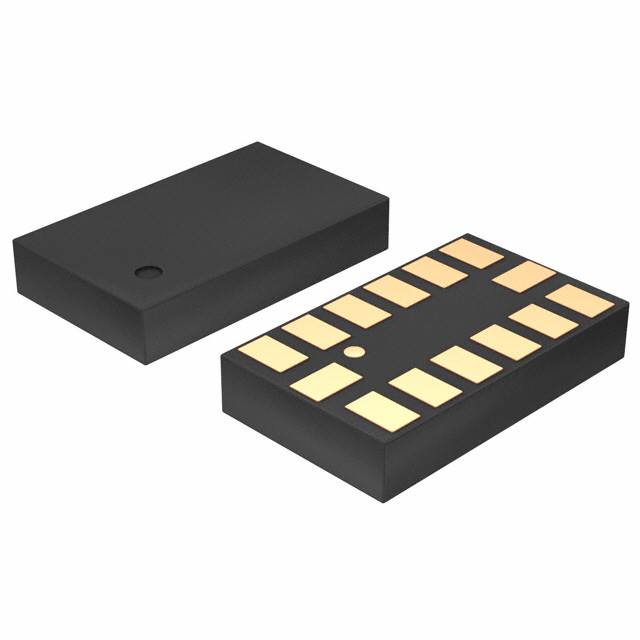
• Small and thin: 3 mm × 5 mm × 1 mm LGA package
• DownloadADXL345-EP data sheet(pdf)
• Extended industrial temperature range: (−55°C to +105°C)
• Controlled manufacturing baseline
• One assembly/test site
• One fabrication site
• Enhanced product change notification
• Qualification data available on request
• V62/12657 DSCC Drawing Number
Description
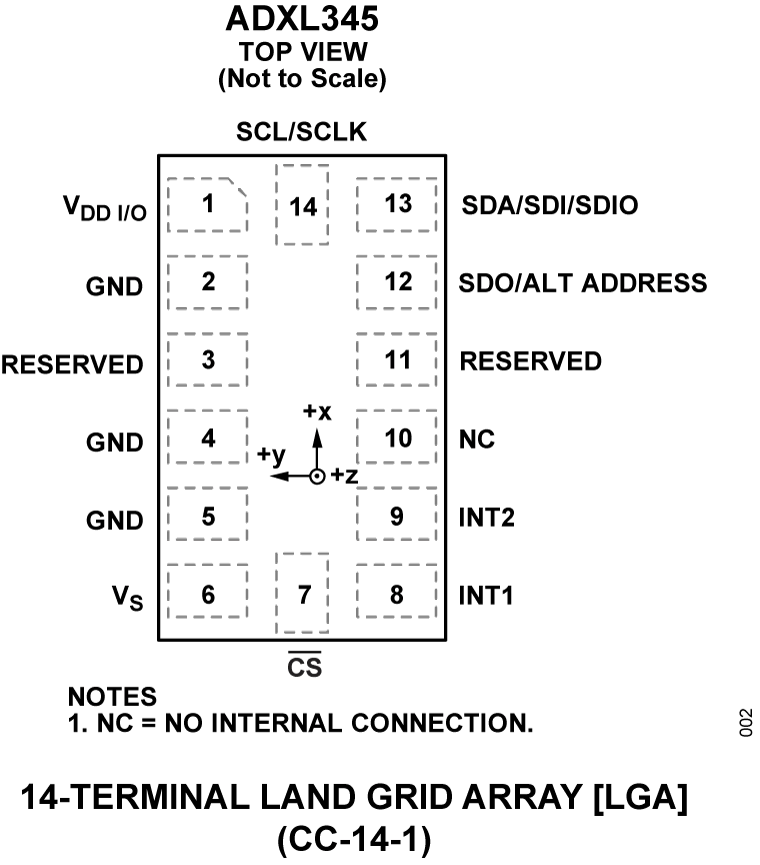
AI
The ADXL345 is a small, thin, low power, 3-axis accelerometer with high resolution (13-bit) measurement at up to ±16g. Digital output data is formatted as 16-bit twos complement and is accessible through either a SPI (3- or 4-wire) or I2C digital interface.The ADXL345 is well suited for mobile device applications. It measures the static acceleration of gravity in tilt-sensing applications, as well as dynamic acceleration resulting from motion or shock. Its high resolution (4 mg/LSB) enables measurement of inclination changes less than 1.0°.Several special sensing functions are provided. Activity and inactivity sensing detect the presence or lack of motion by comparing the acceleration on any axis with user-set thresholds. Tap sensing detects single and double taps in any direction. Free-fall sensing detects if the device is falling. These functions can be mapped individually to either of two interrupt output pins. An integrated memory management system with a 32-level first in, first out (FIFO) buffer can be used to store data to minimize host processor activity and lower overall system power consumption.Low power modes enable intelligent motion-based power management with threshold sensing and active acceleration measurement at extremely low power dissipation.The ADXL345 is supplied in a small, thin, 3 mm × 5 mm × 1 mm, 14-lead, plastic package.ADXL345-EP Supports defense and aerospace applications (AQEC)APPLICATIONSHandsetsMedical instrumentationGaming and pointing devicesIndustrial instrumentationPersonal navigation devicesHard disk drive (HDD) protection