


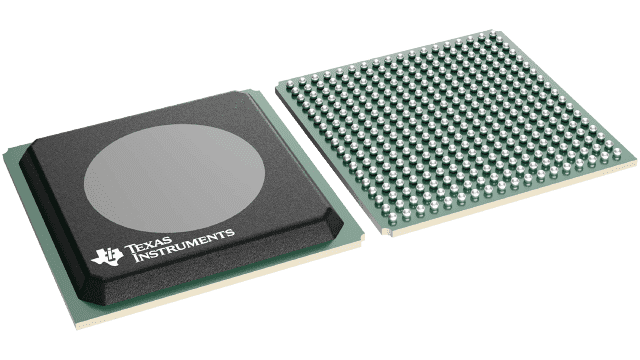
TLK6002 Series
Dual channel 470-Mbps to 6.25-Gbps multi-rate transceiver
Manufacturer: Texas Instruments
Catalog
Dual channel 470-Mbps to 6.25-Gbps multi-rate transceiver
Key Features
• Dual Channel 470Mbps to 6.25Gbps Continuous/Multi-Rate TransceiverSupports all CPRI and OBSAI Data RatesIntegrated Latency Measurement Function, Accuracy of ±814 psCPRI/OBSAI Automated Rate Sense (ARS) FunctionSupports SERDES Operation, 8B/10B Data Modes (20-bit and 16-bit + Controls)20-bit HSTL Single-Ended Parallel Data Interface (Integrated Source andEnd Termination)Shared or Independent Reference Clock per ChannelLatency/Depth Configurable Transmit and Receive FIFOs.Loopback Capability (Serial and Parallel Side), OBSAI CompliantSupports Serial Retime OperationSupports PRBS (27–1), (223– 1) and (231–1) andCRPAT Long/Short Generation and VerificationDual Power Supply: 1.0V Core, and 1.5V/1.8V I/O Nominal SupplySerial Side Three Tap Transmit De-emphasis and Receive Adaptive Equalizationto Allow Extended Backplane ReachProgrammable Output Swing on Serial OutputMinimum Receiver Differential Input Thresholds of 100mVdfppLoss of Signal (LOS) detection (≤75 mVdfpp)Interface to Back Plane, Copper Cables, or Optical ModulesHot Plug ProtectionJTAG; IEEE 1149.1 /1149.6 Test InterfaceMDIO; IEEE 802.3 Clause-22 Support65nm Advanced CMOS TechnologyIndustrial Ambient Operating Temp(–40°C to 85°C) at Full RateDevice Package; 324 PBGAAPPLICATIONSWI InfrastructureCPRI and OBSAI LinksProprietary LinksBackplaneHigh Speed Point- to-Point Transmission SystemsDual Channel 470Mbps to 6.25Gbps Continuous/Multi-Rate TransceiverSupports all CPRI and OBSAI Data RatesIntegrated Latency Measurement Function, Accuracy of ±814 psCPRI/OBSAI Automated Rate Sense (ARS) FunctionSupports SERDES Operation, 8B/10B Data Modes (20-bit and 16-bit + Controls)20-bit HSTL Single-Ended Parallel Data Interface (Integrated Source andEnd Termination)Shared or Independent Reference Clock per ChannelLatency/Depth Configurable Transmit and Receive FIFOs.Loopback Capability (Serial and Parallel Side), OBSAI CompliantSupports Serial Retime OperationSupports PRBS (27–1), (223– 1) and (231–1) andCRPAT Long/Short Generation and VerificationDual Power Supply: 1.0V Core, and 1.5V/1.8V I/O Nominal SupplySerial Side Three Tap Transmit De-emphasis and Receive Adaptive Equalizationto Allow Extended Backplane ReachProgrammable Output Swing on Serial OutputMinimum Receiver Differential Input Thresholds of 100mVdfppLoss of Signal (LOS) detection (≤75 mVdfpp)Interface to Back Plane, Copper Cables, or Optical ModulesHot Plug ProtectionJTAG; IEEE 1149.1 /1149.6 Test InterfaceMDIO; IEEE 802.3 Clause-22 Support65nm Advanced CMOS TechnologyIndustrial Ambient Operating Temp(–40°C to 85°C) at Full RateDevice Package; 324 PBGAAPPLICATIONSWI InfrastructureCPRI and OBSAI LinksProprietary LinksBackplaneHigh Speed Point- to-Point Transmission Systems
Description
AI
The TLK6002 is a member of a portfolio of multi-gigabit transceivers, intended for use in ultra-high-speed bi-directional point-to-point data transmission systems. It is specifically intended for base station RRH (Remote Radio Head) application, but may also be used in other high speed applications. The TLK6002 supports a serial interface speed of 0.470 Gbps to 6.25 Gbps. Rate support includes all the CPRI and OBSAI rates (0.6144/0.768/1.2288/1.536/2.4576/3.072/4.9152/6.144 Gbps) using a single fixed reference clock frequency (either 122.88 MHz or 153.6 MHz).
TLK6002 20-bit parallel interface operates in 1.5V or 1.8V HSTL single-ended format. The 20-bit interface allows low speed signals on the parallel side and therefore enabling the use of low cost FPGA in the system design. The parallel interface can be programmed to be in SDR (Single Data Rate) or DDR (Double Data Rate) modes. The line rate may be set to full (≤6.25Gbps), half (≤3.75Gbps), quarter (≤1.88Gbps) or eighth (≤0.94Gbps). The line rate can be set using either device inputs or software control registers.
The TLK6002 performs data conversion parallel-to-serial, serial-to-parallel and clock extraction as a physical layer interface device. The serial transceiver interface operates at a maximum serial data rate of 6.25 Gbps.
TLK6002 accepts single-ended HSTL signals at its parallel transmit and receive data buses. If the internal 8B/10B coding and decoding are enabled, TDA/B_[19:0] are latched by TXCLK_A/B and sent to the internal 8b/10b encoder, where the resulting encoded words are serialized and transmitted differentially using a line clock derived from the SERDES reference clock at the desired line rate. If the internal coding and decoding are disabled, TDA/B_[19:0] are defined as 20-bits of data being serialized and transmitted unmodified according to the desired line rate.
The receive direction performs the serial-to-parallel conversion on the input serial data synchronizing the resulting 20-bit parallel data to the recovered byte clock (RXCLK_A/B). The optionally decoded receive data is available on the RDA/B_[19:0] output signals.
The serial transmitter and receiver are implemented using differential Current Mode Logic (CML) with integrated termination resistors.
The TLK6002 provides two local (parallel side) and two remote (serial side) loopback modes for self-test and system diagnostic purposes.
The TLK6002 has an integrated loss of signal (LOS) detection function, which is asserted in conditions where the serial input signal does not have sufficient voltage amplitude (≤75 mVdfpp). Note that the input signal must be ≥150 mVdfppwhen loss of signal replacement of the receive datapath data is enabled (register bit 6.6).
The TLK6002 is a member of a portfolio of multi-gigabit transceivers, intended for use in ultra-high-speed bi-directional point-to-point data transmission systems. It is specifically intended for base station RRH (Remote Radio Head) application, but may also be used in other high speed applications. The TLK6002 supports a serial interface speed of 0.470 Gbps to 6.25 Gbps. Rate support includes all the CPRI and OBSAI rates (0.6144/0.768/1.2288/1.536/2.4576/3.072/4.9152/6.144 Gbps) using a single fixed reference clock frequency (either 122.88 MHz or 153.6 MHz).
TLK6002 20-bit parallel interface operates in 1.5V or 1.8V HSTL single-ended format. The 20-bit interface allows low speed signals on the parallel side and therefore enabling the use of low cost FPGA in the system design. The parallel interface can be programmed to be in SDR (Single Data Rate) or DDR (Double Data Rate) modes. The line rate may be set to full (≤6.25Gbps), half (≤3.75Gbps), quarter (≤1.88Gbps) or eighth (≤0.94Gbps). The line rate can be set using either device inputs or software control registers.
The TLK6002 performs data conversion parallel-to-serial, serial-to-parallel and clock extraction as a physical layer interface device. The serial transceiver interface operates at a maximum serial data rate of 6.25 Gbps.
TLK6002 accepts single-ended HSTL signals at its parallel transmit and receive data buses. If the internal 8B/10B coding and decoding are enabled, TDA/B_[19:0] are latched by TXCLK_A/B and sent to the internal 8b/10b encoder, where the resulting encoded words are serialized and transmitted differentially using a line clock derived from the SERDES reference clock at the desired line rate. If the internal coding and decoding are disabled, TDA/B_[19:0] are defined as 20-bits of data being serialized and transmitted unmodified according to the desired line rate.
The receive direction performs the serial-to-parallel conversion on the input serial data synchronizing the resulting 20-bit parallel data to the recovered byte clock (RXCLK_A/B). The optionally decoded receive data is available on the RDA/B_[19:0] output signals.
The serial transmitter and receiver are implemented using differential Current Mode Logic (CML) with integrated termination resistors.
The TLK6002 provides two local (parallel side) and two remote (serial side) loopback modes for self-test and system diagnostic purposes.
The TLK6002 has an integrated loss of signal (LOS) detection function, which is asserted in conditions where the serial input signal does not have sufficient voltage amplitude (≤75 mVdfpp). Note that the input signal must be ≥150 mVdfppwhen loss of signal replacement of the receive datapath data is enabled (register bit 6.6).