Catalog
Industry’s lowest power with robust security
Key Features
• Processor:* ARM Cortex-M23
• * 32 MHz (2.62 CoreMark/MHz and up to 31 DMIPS)
• * Single-cycle hardware multiplier
• * Hardware divider
• * Nested Vector Interrupt Controller (NVIC)
• * Memory Protection Unit (MPU)
•
• Operating Voltage Range:* 1.62V to 3.63V
•
• Memory:* 64 KB Flash
• * 16 KB SRAM
• * 2 KB Data Flash section for non-volatile data storage
• * 256 bytes TrustRAM with physical protection features
•
• Ultra-Low Power:* Active, Idle, Standby with partial or full SRAM retention and off sleep modes
• * Active mode (< 25 μA/MHz)
• * Idle mode (< 10 μA/MHz) with 1.5 μs wake-up time
• * Standby with Full SRAM Retention (0.5 μA) with 5.3 μs wake-up time
• * Off mode (< 100 nA)
•
• Enhanced Peripheral Touch Controller (PTC):* Driven Shield Plus for moisture tolerance and noise immunity
• * Parallel Acquisition through Polarity control
• * Supports wake-up on touch from Standby Sleep mode
•
• Advanced Analog:* 12-bit, 1 MSPS Analog-to-Digital Converter (ADC)
• * Analog Comparators (AC) with window compare function
• * 10-bit, 350 KSPS DAC with external and internal outputs
• * Operational Amplifiers
•
• Serial Communication Interfaces (SERCOM) that can operate as:* USART, I2C, LIN, SPI, ISO7816, RS-485
•
• Qualification and Class-B Support:* AEC-Q100 REVH (Grade 1 [-40ºC to +125ºC]) (planned)
• * Class-B safety library, IEC 60730 (planned)
•
• Temperature options:* -40 C to 85 C
• * -40 C to 125 C
•
• Development Support:* Atmel Studio 7 IDE
• * Atmel START Software Framework
• * Two-pin Serial Wire Debug (SWD) programming and debugging interface
Description
AI
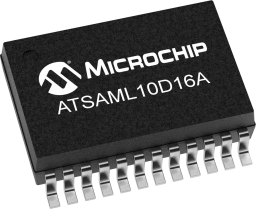
Industry’s first and lowest power Arm® Cortex®-M23 MCU consuming less than 25 uA/MHz in active mode and less than 100 nA in sleep mode. It features enhanced peripheral touch controller, advanced analog, ISO7816 smart card interface, event system and SleepWalking peripherals.
SAM L10 achieved EEMBC Certified ULPMark Core Profile score of 396 & Peripheral Profile score of 166
Supported by MPLAB X IDE and [MPLAB Harmony](https://www.microchip.com/en-us/tools-resources/configure/mplab-harmony).