


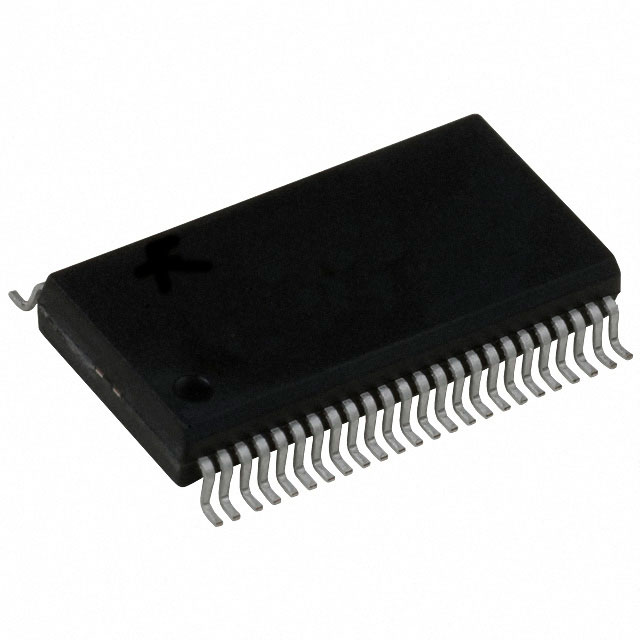
SN75C23243DGGR
Obsolete3- TO 5.5-V MULTICHANNEL 250KBPS RS-232 LINE DRIVER/RECEIVER WITH +/-15-KV ESD PROTECTION
Deep-Dive with AI
Search across all available documentation for this part.
SN75C23243DGGR
Obsolete3- TO 5.5-V MULTICHANNEL 250KBPS RS-232 LINE DRIVER/RECEIVER WITH +/-15-KV ESD PROTECTION
Deep-Dive with AI
Technical Specifications
Parameters and characteristics for this part
| Specification | SN75C23243DGGR |
|---|---|
| Data Rate | 250 KBd |
| Duplex | Full |
| Mounting Type | Surface Mount |
| Number of Drivers/Receivers [custom] | 6 |
| Number of Drivers/Receivers [custom] | 10 |
| Operating Temperature [Max] | 70 °C |
| Operating Temperature [Min] | 0 °C |
| Package / Case | 48-TFSOP |
| Package / Case | 0.24 in |
| Package / Case [custom] | 6.1 mm |
| Protocol | RS232 |
| Receiver Hysteresis | 500 mV |
| Supplier Device Package | 48-TSSOP |
| Type | Transceiver |
| Voltage - Supply [Max] | 5.5 V |
| Voltage - Supply [Min] | 3 V |
Pricing
Prices provided here are for design reference only. For realtime values and availability, please visit the distributors directly
| Distributor | Package | Quantity | $ | |
|---|---|---|---|---|
| Texas Instruments | LARGE T&R | 1 | $ 3.97 | |
| 100 | $ 3.23 | |||
| 250 | $ 2.54 | |||
| 1000 | $ 2.16 | |||
Description
General part information
SN75C23243 Series
The SN65C23243 and SN75C23243 consist of two ports, each containing three line drivers and five line receivers, and a dual charge-pump circuit with ±15-kV ESD protection pin to pin (serial-port connection pins, including GND). These devices meet the requirements of TIA/EIA-232-F and provide the electrical interface between an asynchronous communication controller and the serial-port connector. This combination of drivers and receivers matches that needed for two typical serial ports used in an IBM PC/AT, or compatible. The charge pump and four small external capacitors allow operation from a single 3-V to 5.5-V supply. In addition, these devices include an always-active noninverting output (ROUT2\) per port, which allows applications using the ring indicator to transmit data while the devices are powered down. The devices operate at data signaling rates up to 250 kbit/s, and a maximum of 30-V/µs driver output slew-rate.
Flexible control options for power management are available when either or both serial ports are inactive. The auto-powerdown feature functions when FORCEON is low and FORCEOFF\ is high. During this mode of operation, if the device does not sense a valid RS-232 signal, the driver outputs of its respective port are disabled. If FORCEOFF\ is set low, both drivers and receivers (except ROUT2\) are shut off, and the supply current is reduced to 1 µA. Disconnecting the serial port or turning off the peripheral drivers causes the auto-powerdown condition to occur.
Auto-powerdown can be disabled when FORCEON and FORCEOFF\ are high, and should be done when driving a serial mouse. With auto-powerdown enabled, the RS-232 port is activated automatically when a valid signal is applied to any respective receiver input. The INV\ output is used to notify the user if an RS-232 signal is present at any receiver input. INV\ is high (valid data) if any receiver input voltage is greater than 2.7 V or less than –2.7 V or has been between –0.3 V and 0.3 V for less than 30 µs. INV\ is low (invalid data) if all receiver input voltages are between –0.3 V and 0.3 V for more than 30 µs. Refer to Figure 5 for receiver input levels.
Documents
Technical documentation and resources