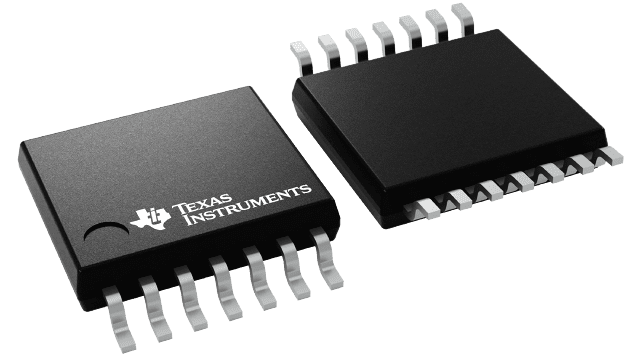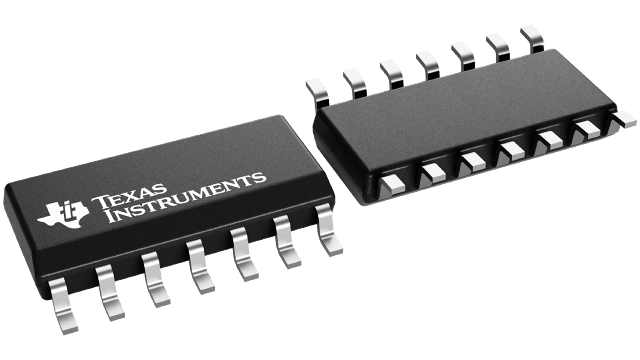
TLV3544IDR
ActiveQUAD, 200MHZ, RRIO, CMOS OPERATIONAL AMPLIFIER
Deep-Dive with AI
Search across all available documentation for this part.
TLV3544IDR
ActiveQUAD, 200MHZ, RRIO, CMOS OPERATIONAL AMPLIFIER
Deep-Dive with AI
Technical Specifications
Parameters and characteristics for this part
| Specification | TLV3544IDR |
|---|---|
| -3db Bandwidth | 200 MHz |
| Amplifier Type | CMOS |
| Current - Input Bias | 3 pA |
| Current - Output / Channel | 100 mA |
| Current - Supply | 5.2 mA |
| Gain Bandwidth Product | 100 MHz |
| Mounting Type | Surface Mount |
| Number of Circuits | 4 |
| Operating Temperature [Max] | 125 °C |
| Operating Temperature [Min] | -40 °C |
| Output Type | Rail-to-Rail |
| Package / Case | 14-SOIC |
| Package / Case [x] | 0.154 in |
| Package / Case [y] | 3.9 mm |
| Slew Rate | 150 V/µs |
| Voltage - Input Offset | 2 mV |
| Voltage - Supply Span (Max) [Max] | 5.5 V |
| Voltage - Supply Span (Min) [Min] | 2.5 V |
Pricing
Prices provided here are for design reference only. For realtime values and availability, please visit the distributors directly
| Distributor | Package | Quantity | $ | |
|---|---|---|---|---|
| Digikey | Cut Tape (CT) | 1 | $ 2.70 | |
| 10 | $ 2.42 | |||
| 25 | $ 2.29 | |||
| 100 | $ 1.95 | |||
| 250 | $ 1.83 | |||
| 500 | $ 1.60 | |||
| 1000 | $ 1.33 | |||
| Digi-Reel® | 1 | $ 2.70 | ||
| 10 | $ 2.42 | |||
| 25 | $ 2.29 | |||
| 100 | $ 1.95 | |||
| 250 | $ 1.83 | |||
| 500 | $ 1.60 | |||
| 1000 | $ 1.33 | |||
| Tape & Reel (TR) | 2500 | $ 1.24 | ||
| 5000 | $ 1.19 | |||
| Texas Instruments | LARGE T&R | 1 | $ 2.03 | |
| 100 | $ 1.68 | |||
| 250 | $ 1.20 | |||
| 1000 | $ 0.91 | |||
Description
General part information
TLV3544-Q1 Series
The TLV3544-Q1 series of high-speed, voltage-feedback CMOS operational amplifiers (op amps) are designed for video and other applications requiring wide bandwidth. They are unity-gain stable and can drive large output currents. Differential gain is 0.02% and differential phase is 0.09°. Quiescent current is only 4.9 mA per channel.
The TLV3544-Q1 quad-channel op amp is optimized for operation on single or dual supplies as low as 2.5 V (±1.25 V) and up to 5.5 V (±2.75 V). Common-mode input range extends beyond the supplies. The output swing is within 100 mV of the rails, supporting wide dynamic range.
Multichannel version feature completely independent circuitry for lowest crosstalk and freedom from interaction. All are specified over the extended –40°C to +125°C temperature range.
Documents
Technical documentation and resources