TPS63811YFFR
Active2.5-A HIGH-EFFICIENT BUCK-BOOST CONVERTER WITH I²C INTERFACE FOR DYNAMIC VOLTAGE SCALING
Deep-Dive with AI
Search across all available documentation for this part.
TPS63811YFFR
Active2.5-A HIGH-EFFICIENT BUCK-BOOST CONVERTER WITH I²C INTERFACE FOR DYNAMIC VOLTAGE SCALING
Technical Specifications
Parameters and characteristics for this part
| Specification | TPS63811YFFR |
|---|---|
| Current - Output | 2.5 A |
| Frequency - Switching | 1.6 MHz, 2.6 MHz, 2 MHz |
| Function | Step-Down, Step-Up |
| Mounting Type | Surface Mount |
| Number of Outputs | 1 |
| Operating Temperature [Max] | 85 C |
| Operating Temperature [Min] | -40 ¯C |
| Output Configuration | Positive |
| Output Type | Adjustable |
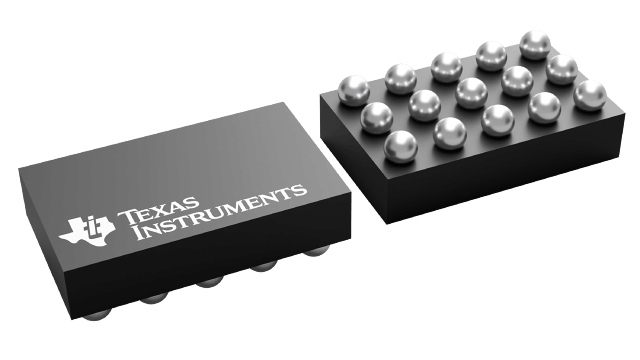
| Package / Case | DSBGA, 15-UFBGA |
| Supplier Device Package | 15-DSBGA |
| Synchronous Rectifier | False |
| Topology | Buck-Boost |
| Voltage - Input (Max) [Max] | 5.5 V |
| Voltage - Input (Min) [Min] | 2.2 V |
| Voltage - Output (Max) [Max] | 5.2 V |
| Voltage - Output (Min/Fixed) | 1.8 V |
Pricing
Prices provided here are for design reference only. For realtime values and availability, please visit the distributors directly
| Distributor | Package | Quantity | $ | |
|---|---|---|---|---|
| Digikey | Cut Tape (CT) | 1 | $ 2.68 | |
| 10 | $ 2.41 | |||
| 25 | $ 2.27 | |||
| 100 | $ 1.94 | |||
| 250 | $ 1.82 | |||
| 500 | $ 1.59 | |||
| 1000 | $ 1.32 | |||
| Digi-Reel® | 1 | $ 2.68 | ||
| 10 | $ 2.41 | |||
| 25 | $ 2.27 | |||
| 100 | $ 1.94 | |||
| 250 | $ 1.82 | |||
| 500 | $ 1.59 | |||
| 1000 | $ 1.32 | |||
| N/A | 5389 | $ 2.71 | ||
| Tape & Reel (TR) | 3000 | $ 1.23 | ||
| 6000 | $ 1.18 | |||
| Texas Instruments | LARGE T&R | 1 | $ 2.02 | |
| 100 | $ 1.67 | |||
| 250 | $ 1.20 | |||
| 1000 | $ 0.90 | |||
Description
General part information
TPS63811 Series
The TPS63810 and TPS63811 are high efficiency, high output current buck-boost converters fully programmable through I2C. Depending on the input voltage, they automatically operate in boost, buck or in a novel 4-cycle buck-boost mode when the input voltage is approximately equal to the output voltage.
The transitions between modes happen at defined thresholds and avoid unwanted toggling within the modes to reduce output voltage ripple.
Two registers, accessible through I2C, set the output voltage, and a VSEL pin selects which output voltage register is active. Thus the devices can support dynamic voltage scaling. If the output voltage register is changed during operation or the VSEL pin is toggled, the device transits in a defined, programmable ramp-rate.
Documents
Technical documentation and resources