


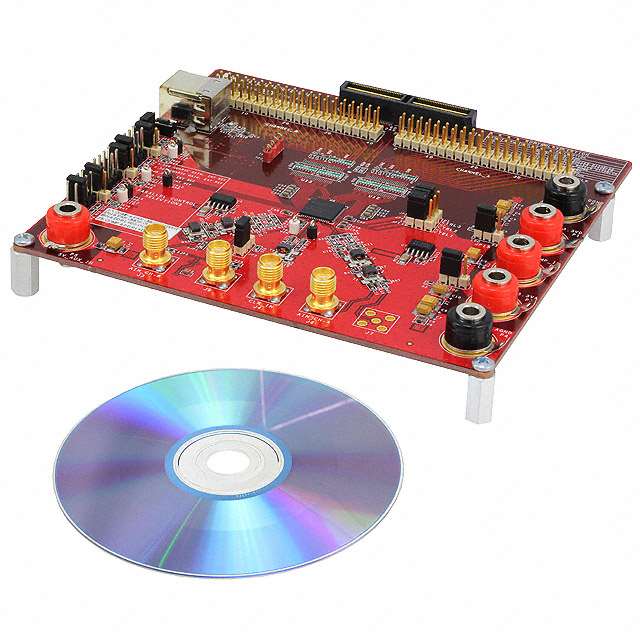
ADS62P24EVM
ObsoleteADS62P24 ADC EVALUATION BOARD 105MSPS ADC SPI CONTROL IDE
Deep-Dive with AI
Search across all available documentation for this part.
ADS62P24EVM
ObsoleteADS62P24 ADC EVALUATION BOARD 105MSPS ADC SPI CONTROL IDE
Deep-Dive with AI
Technical Specifications
Parameters and characteristics for this part
| Specification | ADS62P24EVM |
|---|---|
| Data Interface | Serial, Parallel |
| Input Range | 2 Vpp |
| Number of A/D Converters | 1 |
| Number of Bits | 12 bits |
| Power (Typ) @ Conditions | 710 mW |
| Sampling Rate (Per Second) | 105 M |
| Supplied Contents | Board(s) |
| Utilized IC / Part | ADS62P24 |
Pricing
Prices provided here are for design reference only. For realtime values and availability, please visit the distributors directly
| Distributor | Package | Quantity | $ | |
|---|---|---|---|---|
| Digikey | Box | 1 | $ 315.74 | |
Description
General part information
ADS62P24 Series
ADS62P2X is a dual channel 12-bit A/D converter family with maximum sample rates up to 125 MSPS. It combines high performance and low power consumption in a compact 64 QFN package. Using an internal sample and hold and low jitter clock buffer, the ADC supports high SNR and high SFDR at high input frequencies. It has coarse and fine gain options that can be used to improve SFDR performance at lower full-scale input ranges.
ADS62P2X includes a digital processing block that consists of several useful and commonly used digital functions such as ADC offset correction, fine gain correction (in steps of 0.05 dB), decimation by 2,4,8 and in-built and custom programmable filters. By default, the digital processing block is bypassed, and its functions are disabled.
Two output interface options exist – parallel CMOS and DDR LVDS (Double Data Rate). ADS62P2X includes internal references while traditional reference pins and associated decoupling capacitors have been eliminated. Nevertheless, the device can also be driven with an external reference. The device is specified over the industrial temperature range (–40°C to 85°C).
Documents
Technical documentation and resources
No documents available