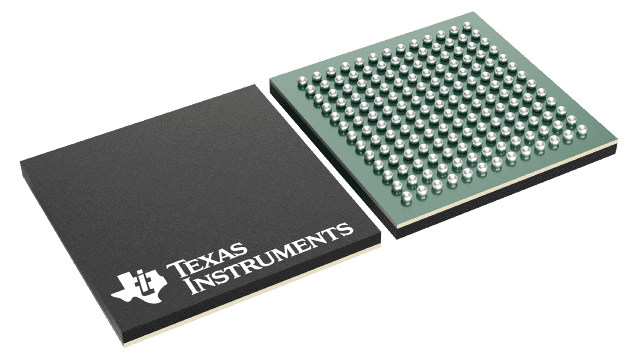
TPS6590379ZWSR
ActivePOWER MANAGEMENT IC (PMIC) FOR ARM CORTEX A15 PROCESSORS
Deep-Dive with AI
Search across all available documentation for this part.
TPS6590379ZWSR
ActivePOWER MANAGEMENT IC (PMIC) FOR ARM CORTEX A15 PROCESSORS
Deep-Dive with AI
Technical Specifications
Parameters and characteristics for this part
| Specification | TPS6590379ZWSR |
|---|---|
| Applications | Processor |
| Mounting Type | Surface Mount |
| Operating Temperature [Max] | 85 °C |
| Operating Temperature [Min] | -40 C |
| Package / Case | 169-LFBGA |
| Supplier Device Package | 169-NFBGA (12x12) |
| Voltage - Supply [Max] | 5.25 V |
| Voltage - Supply [Min] | 3.135 V |
Pricing
Prices provided here are for design reference only. For realtime values and availability, please visit the distributors directly
| Distributor | Package | Quantity | $ | |
|---|---|---|---|---|
| Digikey | Cut Tape (CT) | 1 | $ 11.85 | |
| 10 | $ 10.89 | |||
| 25 | $ 10.44 | |||
| 100 | $ 9.20 | |||
| 250 | $ 8.75 | |||
| 500 | $ 8.18 | |||
| Digi-Reel® | 1 | $ 11.85 | ||
| 10 | $ 10.89 | |||
| 25 | $ 10.44 | |||
| 100 | $ 9.20 | |||
| 250 | $ 8.75 | |||
| 500 | $ 8.18 | |||
| N/A | 1050 | $ 14.08 | ||
| Tape & Reel (TR) | 1000 | $ 7.51 | ||
| Texas Instruments | LARGE T&R | 1 | $ 9.28 | |
| 100 | $ 8.10 | |||
| 250 | $ 6.25 | |||
| 1000 | $ 5.59 | |||
Description
General part information
TPS659037 Series
The TPS659037 device is an integrated power-management IC (PMIC). The device provides seven configurable step-down converters with up to 6 A of output current for memory, processor core, input-output (I/O), or preregulation of LDOs. One of these configurable step-down converters can be combined with another 3-A regulator to allow up to 9 A of output current. All of the step-down converters can synchronize to an external clock source between 1.7 MHz and 2.7 MHz, or an internal fallback clock at 2.2 MHz.
The TPS659037 device contains seven LDO regulators for external use. These LDO regulators can be supplied from either a system supply or a preregulated supply. The power-up and power-down controller is configurable and supports any power-up and power-down sequences (OTP based). The TPS659037 device includes a 32-kHz RC oscillator to sequence all resources during power up and power down. In cases where a fast start up is needed, a 16-MHz crystal oscillator is also included to quickly generate a stable 32-kHz for the system. All LDOs and SMPS converters can be controlled by the SPI or I2C interface, or by power request signals. In addition, voltage scaling registers allow transitioning the SMPS to different voltages by SPI, I2C, or roof and floor control.
One dedicated pin in each package can be configured as part of the power-up sequence to control external resources. General-purpose input-output (GPIO) functionality is available and two GPIOs can be configured as part of the power-up sequence to control external resources. Power request signals enable power mode control for power optimization. The device includes a general-purpose sigma-delta analog-to-digital converter (GPADC) with three external input channels.
Documents
Technical documentation and resources