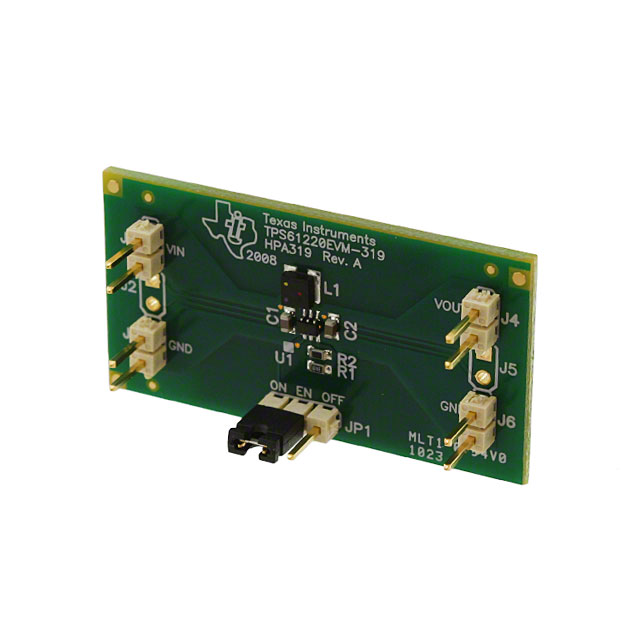
TPS61220EVM-319
ActiveEVAL MODULE FOR TPS61220-319
Deep-Dive with AI
Search across all available documentation for this part.
TPS61220EVM-319
ActiveEVAL MODULE FOR TPS61220-319
Deep-Dive with AI
Technical Specifications
Parameters and characteristics for this part
| Specification | TPS61220EVM-319 |
|---|---|
| Board Type | Fully Populated |
| Contents | Board(s) |
| Main Purpose | DC/DC, Step Up |
| Outputs and Type | 1 |
| Outputs and Type | Non-Isolated, 1 Non-Isolated Output |
| Regulator Topology | Boost |
| Supplied Contents | Board(s) |
| Utilized IC / Part | TPS61220 |
| Voltage - Input [Max] | 5.5 V |
| Voltage - Input [Min] | 0.7 V |
| Voltage - Output | 3.3 V |
Pricing
Prices provided here are for design reference only. For realtime values and availability, please visit the distributors directly
| Distributor | Package | Quantity | $ | |
|---|---|---|---|---|
| Digikey | Box | 1 | $ 58.80 | |
| N/A | 1 | $ 58.80 | ||
Description
General part information
TPS61220 Series
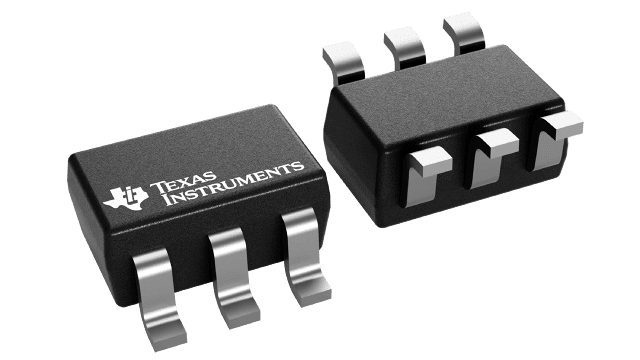
The TPS6122x family devices provide a power-supply solution for products powered by either a single-cell, two-cell, or three-cell alkaline, NiCd or NiMH, or one-cell Li-Ion or Li-polymer battery. Possible output currents depend on the input-to-output voltage ratio. The boost converter is based on a hysteretic controller topology using synchronous rectification to obtain maximum efficiency at minimal quiescent currents. The output voltage of the adjustable version can be programmed by an external resistor divider, or is set internally to a fixed output voltage. The converter can be switched off by a featured enable pin. While being switched off, battery drain is minimized. The device is offered in a 6-pin SC-70 package (DCK) measuring 2 mm × 2 mm to enable small circuit layout size.
The TPS6122x family devices provide a power-supply solution for products powered by either a single-cell, two-cell, or three-cell alkaline, NiCd or NiMH, or one-cell Li-Ion or Li-polymer battery. Possible output currents depend on the input-to-output voltage ratio. The boost converter is based on a hysteretic controller topology using synchronous rectification to obtain maximum efficiency at minimal quiescent currents. The output voltage of the adjustable version can be programmed by an external resistor divider, or is set internally to a fixed output voltage. The converter can be switched off by a featured enable pin. While being switched off, battery drain is minimized. The device is offered in a 6-pin SC-70 package (DCK) measuring 2 mm × 2 mm to enable small circuit layout size.
Documents
Technical documentation and resources