


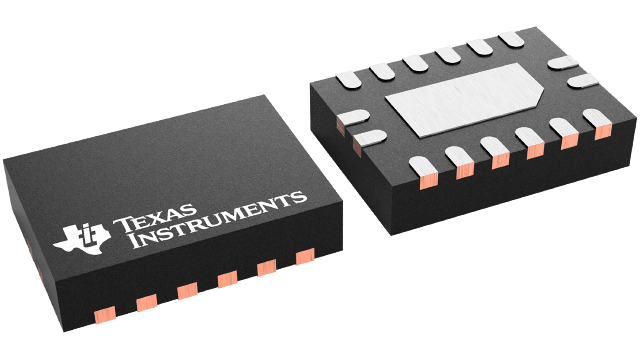
SN74LVC2G100BQBR
ActiveTWO-CHANNEL 1.1V-TO-3.6V CONFIGURABLE GATE WITH FLIP-FLOP AND SCHMITT-TRIGGER INPUTS
Deep-Dive with AI
Search across all available documentation for this part.
SN74LVC2G100BQBR
ActiveTWO-CHANNEL 1.1V-TO-3.6V CONFIGURABLE GATE WITH FLIP-FLOP AND SCHMITT-TRIGGER INPUTS
Deep-Dive with AI
Technical Specifications
Parameters and characteristics for this part
| Specification | SN74LVC2G100BQBR |
|---|---|
| Current - Output High, Low | 24 mA |
| Logic Type | Configurable Multiple Function |
| Mounting Type | Surface Mount |
| Number of Circuits | 1 |
| Number of Inputs | 3 |
| Operating Temperature [Max] | 125 °C |
| Operating Temperature [Min] | -40 °C |
| Output Type | Single-Ended |
| Package / Case | 16-WFQFN Exposed Pad |
| Schmitt Trigger Input | True |
| Supplier Device Package | 16-WQFN (2.5x3.5) |
| Voltage - Supply [Max] | 3.6 V |
| Voltage - Supply [Min] | 1.1 V |
Pricing
Prices provided here are for design reference only. For realtime values and availability, please visit the distributors directly
| Distributor | Package | Quantity | $ | |
|---|---|---|---|---|
| Digikey | Cut Tape (CT) | 1 | $ 0.93 | |
| 10 | $ 0.83 | |||
| 25 | $ 0.79 | |||
| 100 | $ 0.65 | |||
| 250 | $ 0.60 | |||
| 500 | $ 0.53 | |||
| 1000 | $ 0.42 | |||
| Digi-Reel® | 1 | $ 0.93 | ||
| 10 | $ 0.83 | |||
| 25 | $ 0.79 | |||
| 100 | $ 0.65 | |||
| 250 | $ 0.60 | |||
| 500 | $ 0.53 | |||
| 1000 | $ 0.42 | |||
| Tape & Reel (TR) | 3000 | $ 0.39 | ||
| 6000 | $ 0.37 | |||
| 15000 | $ 0.36 | |||
| Texas Instruments | LARGE T&R | 1 | $ 0.69 | |
| 100 | $ 0.53 | |||
| 250 | $ 0.39 | |||
| 1000 | $ 0.28 | |||
Description
General part information
SN74LVC2G100 Series
The SN74LVC2G100 is a dual, sequential, configurable multiple function device with Schmitt Trigger inputs. Sixteen patterns of a 4-bit input determines the output state. The output state serves as the input to a D-Flip Flop, which is transferred to the Q output on the positive going CLK edge. The user can choose the logic functions MUX, AND, OR, NAND, NOR, inverter, and non-inverter.
The SN74LVC2G100 is a dual, sequential, configurable multiple function device with Schmitt Trigger inputs. Sixteen patterns of a 4-bit input determines the output state. The output state serves as the input to a D-Flip Flop, which is transferred to the Q output on the positive going CLK edge. The user can choose the logic functions MUX, AND, OR, NAND, NOR, inverter, and non-inverter.
Documents
Technical documentation and resources