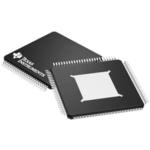
AFE8220IPZPQ1
ActiveAUTOMOTIVE CATALOG DUAL IF INTERFACE FOR DIGITAL RADIO
Deep-Dive with AI
Search across all available documentation for this part.
AFE8220IPZPQ1
ActiveAUTOMOTIVE CATALOG DUAL IF INTERFACE FOR DIGITAL RADIO
Deep-Dive with AI
Technical Specifications
Parameters and characteristics for this part
| Specification | AFE8220IPZPQ1 |
|---|---|
| Frequency [Max] | 75 MHz |
| Frequency [Min] | 0 Hz |
| Grade | Automotive |
| Package / Case | 100-TQFP Exposed Pad |
| Qualification | AEC-Q100 |
| RF Type | AM, FM |
| Supplier Device Package | 100-HTQFP (14x14) |
Pricing
Prices provided here are for design reference only. For realtime values and availability, please visit the distributors directly
| Distributor | Package | Quantity | $ | |
|---|---|---|---|---|
| Digikey | Tray | 90 | $ 44.00 | |
| Texas Instruments | JEDEC TRAY (10+1) | 1 | $ 51.10 | |
| 100 | $ 45.42 | |||
| 250 | $ 37.34 | |||
| 1000 | $ 33.40 | |||
Description
General part information
AFE8220-Q1 Series
The AFE8220 implements the intermediate frequency (IF) sampling and processing functions of a digital radio receiver system. It is designed to be used with TI’s digital radio baseband processors and AM/FM tuners. The AFE8220 can also be programmed by the baseband processor for use in conventional AM/FM and digital radio. This unit includes two IF inputs with associated filtering and digital processing circuitry.
The receive circuit oversamples the radio tuner IF output to reduce noise and improve dynamic range. The IF analog-to-digital converter (ADC) oversamples the IF input at rates up to 75 MHz. The AFE8220 then digitally mixes, filters, and decimates the signal to provide in-phase (I) and quadrature (Q) output signals to the baseband processor. A clock oscillator circuit is provided that can be used with an appropriate third-overtone crystal and external tank circuit to generate the sampling clock for the IF ADCs.
The AFE8220 also includes a real-time clock and associated low-power oscillator circuit. Two auxiliary digital-to-analog converters (DACs) are included for system control functions. Other features include eight general-purpose input/output (GPIO) lines and programmable interrupt generators.
Documents
Technical documentation and resources