


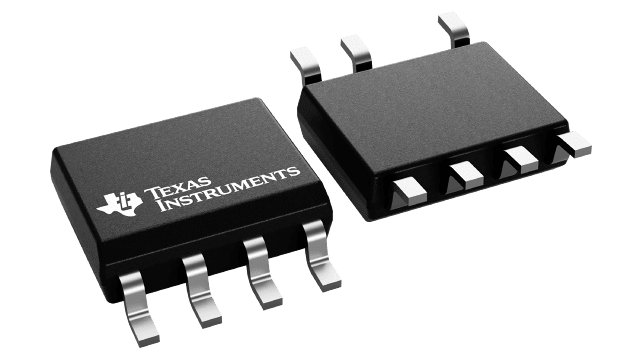
UCC28730QDRQ1
ActiveAC TO DC SWITCHING CONVERTER FLYBACK 90KHZ T/R 7-PIN SOIC AUTOMOTIVE AEC-Q100
Deep-Dive with AI
Search across all available documentation for this part.
UCC28730QDRQ1
ActiveAC TO DC SWITCHING CONVERTER FLYBACK 90KHZ T/R 7-PIN SOIC AUTOMOTIVE AEC-Q100
Technical Specifications
Parameters and characteristics for this part
| Specification | UCC28730QDRQ1 |
|---|---|
| Fault Protection | Over Voltage, Current Limiting |
| Frequency - Switching [Max] | 83 kHz |
| Frequency - Switching [Min] | 32 Hz |
| Grade | Automotive |
| Internal Switch(s) | False |
| Mounting Type | Surface Mount |
| Operating Temperature [Max] | 125 °C |
| Operating Temperature [Min] | -40 C |
| Output Isolation | Isolated |
| Package / Case | 0.154 in, 3.9 mm, 7 Leads |
| Package / Case | 8-SOIC |
| Qualification | AEC-Q100 |
| Supplier Device Package | 7-SOIC |
| Topology | Flyback |
| Voltage - Start Up | 21 V |
| Voltage - Supply (Vcc/Vdd) [Max] | 35 V |
| Voltage - Supply (Vcc/Vdd) [Min] | 9 V |
Pricing
Prices provided here are for design reference only. For realtime values and availability, please visit the distributors directly
| Distributor | Package | Quantity | $ | |
|---|---|---|---|---|
| Digikey | N/A | 1521 | $ 1.69 | |
| Texas Instruments | LARGE T&R | 1 | $ 1.31 | |
| 100 | $ 1.01 | |||
| 250 | $ 0.74 | |||
| 1000 | $ 0.53 | |||
Description
General part information
UCC28730-Q1 Series
The UCC28730-Q1 isolated-flyback power supply controller provides constant-voltage (CV) and constant-current (CC) output regulation without the use of an optical coupler. A minimum switching frequency of 30 Hz achieves less than 5 mW of no-load power.
This device processes information from the primary power switch and an auxiliary flyback winding for precise control of output voltage and current.
An internal 700-V start-up switch, dynamically- controlled operating states and a tailored modulation profile support ultra-low stand-by power without sacrificing start-up time or output transient response. Control algorithms in the UCC28730-Q1 allow operating efficiencies to meet or exceed applicable standards. Discontinuous conduction mode (DCM) operation with valley-switching reduces switching losses. Modulation of the switching frequency and primary current peak amplitude (FM and AM) keeps the conversion efficiency high across the entire load and line ranges.
Documents
Technical documentation and resources