


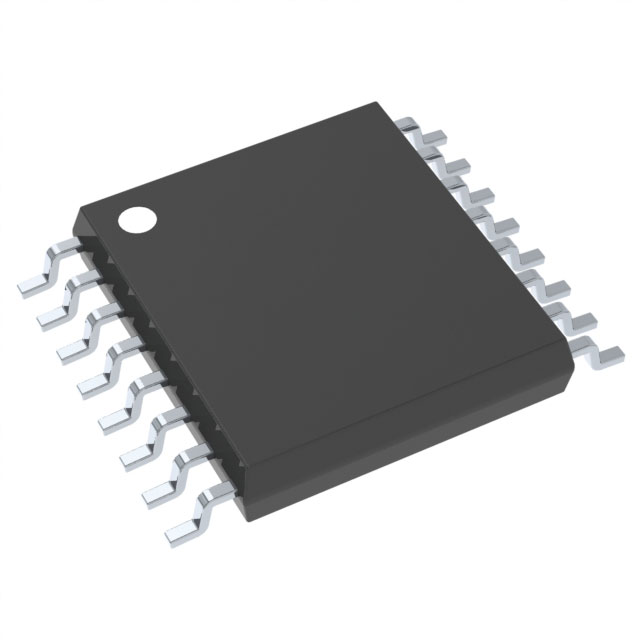
SN65LVDS1050PW
ActiveLVDS TRANSCEIVER 400MBPS 0.454V 16-PIN TSSOP TUBE
Deep-Dive with AI
Search across all available documentation for this part.
SN65LVDS1050PW
ActiveLVDS TRANSCEIVER 400MBPS 0.454V 16-PIN TSSOP TUBE
Technical Specifications
Parameters and characteristics for this part
| Specification | SN65LVDS1050PW |
|---|---|
| Capacitance - Input | 3 pF |
| Current - Supply | 12 mA |
| Data Rate (Max) | 400 Mbps |
| Input | LVTTL, LVDS |
| Mounting Type | Surface Mount |
| Number of Channels [custom] | 2 |
| Operating Temperature [Max] | 85 °C |
| Operating Temperature [Min] | -40 °C |
| Output | LVDS, LVTTL |
| Package / Case | 16-TSSOP |
| Package / Case [x] | 0.173 in |
| Package / Case [y] | 4.4 mm |
| Supplier Device Package | 16-TSSOP |
| Type | ReDriver, Buffer |
| Voltage - Supply [Max] | 3.6 V |
| Voltage - Supply [Min] | 2.4 V |
Pricing
Prices provided here are for design reference only. For realtime values and availability, please visit the distributors directly
| Distributor | Package | Quantity | $ | |
|---|---|---|---|---|
| Digikey | Tube | 1 | $ 6.41 | |
| 10 | $ 4.34 | |||
| 25 | $ 3.80 | |||
| 100 | $ 3.20 | |||
| 250 | $ 2.91 | |||
| 500 | $ 2.73 | |||
| 1000 | $ 2.58 | |||
| 2500 | $ 2.42 | |||
| Texas Instruments | TUBE | 1 | $ 3.96 | |
| 100 | $ 3.47 | |||
| 250 | $ 2.43 | |||
| 1000 | $ 1.96 | |||
Description
General part information
SN65LVDS1050 Series
The SN65LVDS1050 is similar to the SN65LVDS050 except that it is characterized for operation with a lower supply voltage range and packaged in the thin shrink outline package for portable battery-powered applications.
The differential line drivers and receivers use low-voltage differential signaling (LVDS) to achieve signaling rates as high as 400 Mbps. The drivers provide a minimum differential output voltage magnitude of 247 mV into a 100-load and receipt of 100-mV signals with up to 1 V of ground potential difference between a transmitter and receiver.
The intended application of this device and signaling technique is for point-to-point baseband data transmission over controlled impedance media of approximately 100-characteristic impedance. The transmission media may be printed-circuit board traces, backplanes, or cables. Note: The ultimate rate and distance of data transfer is dependent upon the attenuation characteristics of the media, the noise coupling to the environment and other application-specific characteristics.
Documents
Technical documentation and resources