


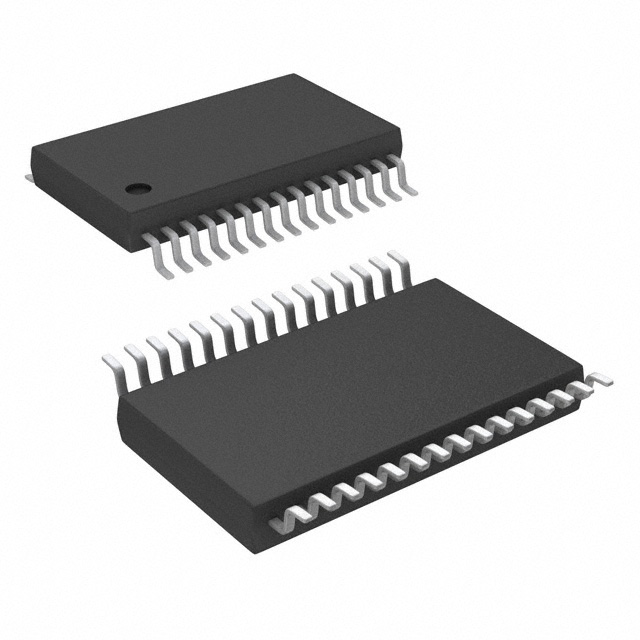
TPS5120DBTR
Active4.5-V TO 28-V, DUAL-OUPTUT, TWO-PHASE SYNCHRONOUS BUCK CONTROLLER
Deep-Dive with AI
Search across all available documentation for this part.
TPS5120DBTR
Active4.5-V TO 28-V, DUAL-OUPTUT, TWO-PHASE SYNCHRONOUS BUCK CONTROLLER
Deep-Dive with AI
Technical Specifications
Parameters and characteristics for this part
| Specification | TPS5120DBTR |
|---|---|
| Clock Sync | False |
| Control Features | Enable, Power Good, Soft Start |
| Duty Cycle (Max) [Max] | 83 % |
| Frequency - Switching | 300 kHz |
| Function | Step-Down |
| Mounting Type | Surface Mount |
| Number of Outputs | 2 |
| Operating Temperature [Max] | 85 °C |
| Operating Temperature [Min] | -40 °C |
| Output Configuration | Positive |
| Output Phases | 2 |
| Output Type | Transistor Driver |
| Package / Case | 30-TFSOP |
| Package / Case [x] | 0.173 in |
| Package / Case [y] | 4.4 mm Width |
| Supplier Device Package | 30-TSSOP |
| Synchronous Rectifier | True |
| Topology | Buck |
| Voltage - Supply (Vcc/Vdd) [Max] | 28 V |
| Voltage - Supply (Vcc/Vdd) [Min] | 4.5 V |
Pricing
Prices provided here are for design reference only. For realtime values and availability, please visit the distributors directly
| Distributor | Package | Quantity | $ | |
|---|---|---|---|---|
| Digikey | Cut Tape (CT) | 1 | $ 6.52 | |
| 10 | $ 4.51 | |||
| 25 | $ 3.99 | |||
| 100 | $ 3.90 | |||
| Digi-Reel® | 1 | $ 6.52 | ||
| 10 | $ 4.51 | |||
| 25 | $ 3.99 | |||
| 100 | $ 3.90 | |||
| Tape & Reel (TR) | 2000 | $ 3.90 | ||
| Texas Instruments | LARGE T&R | 1 | $ 6.32 | |
| 100 | $ 5.15 | |||
| 250 | $ 4.05 | |||
| 1000 | $ 3.43 | |||
Description
General part information
TPS5120-Q1 Series
The TPS5120 is a dual channel, high-efficiency synchronous buck controller where the outputs run 180 degrees out of phase, which lowers the input current ripple, thereby reducing the input capacitance cost. The PWM/SKIP pin allows the operating mode to switch from PWM mode to skip mode under light load conditions. The skip mode enables a lower operating frequency and shortens the pulse width to the low-side MOSFET, increasing the efficiency under light load conditions. These two modes, along with synchronous-rectifier drivers, dead time, and very low quiescent current, allow power to be conserved and the battery life to be extended under all load conditions. The 1.5 A (typical) high-side and low-side MOSFET drivers on-chip are designed to drive less expensive N-channel MOSFETs. The resistorless current protection and fixed high-side driver voltage simplify the power supply design and reduce the external parts count. Each channel is independent, offering a separate controller, overcurrent protection, and standby control. Sequencing is flexible and can be tailored by choosing different softstart capacitor values. Other features, such as undervoltage lockout, power good, overvoltage, undervoltage, and programmable short-circuit protection promote system reliability.
The TPS5120 is a dual channel, high-efficiency synchronous buck controller where the outputs run 180 degrees out of phase, which lowers the input current ripple, thereby reducing the input capacitance cost. The PWM/SKIP pin allows the operating mode to switch from PWM mode to skip mode under light load conditions. The skip mode enables a lower operating frequency and shortens the pulse width to the low-side MOSFET, increasing the efficiency under light load conditions. These two modes, along with synchronous-rectifier drivers, dead time, and very low quiescent current, allow power to be conserved and the battery life to be extended under all load conditions. The 1.5 A (typical) high-side and low-side MOSFET drivers on-chip are designed to drive less expensive N-channel MOSFETs. The resistorless current protection and fixed high-side driver voltage simplify the power supply design and reduce the external parts count. Each channel is independent, offering a separate controller, overcurrent protection, and standby control. Sequencing is flexible and can be tailored by choosing different softstart capacitor values. Other features, such as undervoltage lockout, power good, overvoltage, undervoltage, and programmable short-circuit protection promote system reliability.
Documents
Technical documentation and resources