Deep-Dive with AI
Search across all available documentation for this part.
Deep-Dive with AI
Technical Specifications
Parameters and characteristics for this part
| Specification | TPS23758EVM-080 |
|---|---|
| Embedded | False |
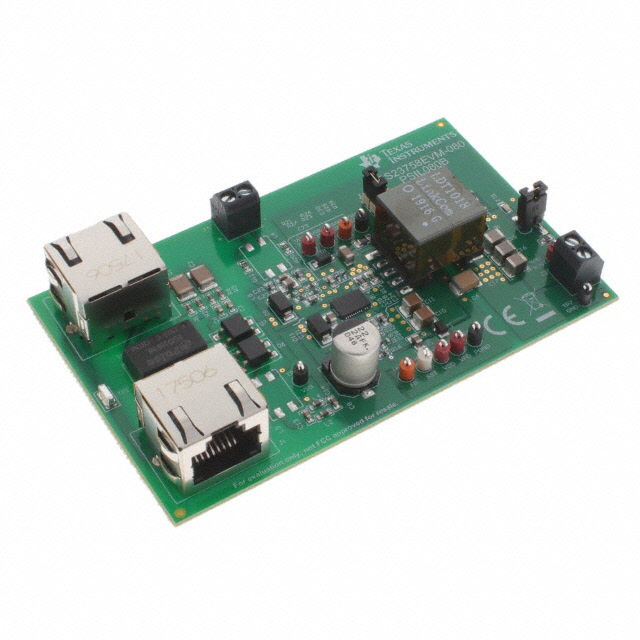
| Function | Power Over Ethernet (POE) |
| Secondary Attributes | On-Board LEDs, Test Points |
| Supplied Contents | Board(s) |
| Type | Power Management |
| Utilized IC / Part | TPS23758 |
Pricing
Prices provided here are for design reference only. For realtime values and availability, please visit the distributors directly
| Distributor | Package | Quantity | $ | |
|---|---|---|---|---|
| Digikey | Box | 1 | $ 178.80 | |
Description
General part information
TPS23758 Series
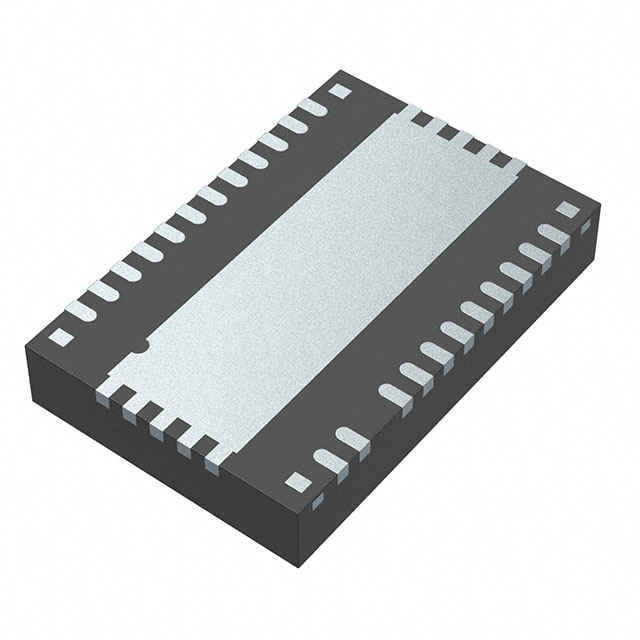
The TPS23758 device combines a Power over Ethernet (PoE) powered device (PD) interface, a 150-V switching power FET, and a current-mode DC-DC controller optimized for flyback topology. The high level of integration along with primary side regulation (PSR), spread spectrum frequency dithering (SSFD), and advanced startup makes the TPS23758 an ideal solution for size-constrained applications. The PoE implementation supports the IEEE 802.3at standard as a 13-W, Type 1 PD.
The PSR feature of the DC-DC controller uses feedback from an auxiliary winding for control of the output voltage, eliminating the need for external shunt regulator and optocoupler. It is optimized for operation in continuous conduction mode (CCM) with secondary side synchronous rectification, resulting in optimum overall efficiency, regulation accuracy and step load response over multiple outputs (for example 5-V and 3.3-V output). Typically, the converter operates at a switching frequency of 250 kHz.
SFFD and slew rate control helps to minimize the size and cost of the EMI filter. Advanced Startup allows the use of minimal bias capacitor while simplifying converter startup and hiccup design.
Documents
Technical documentation and resources