


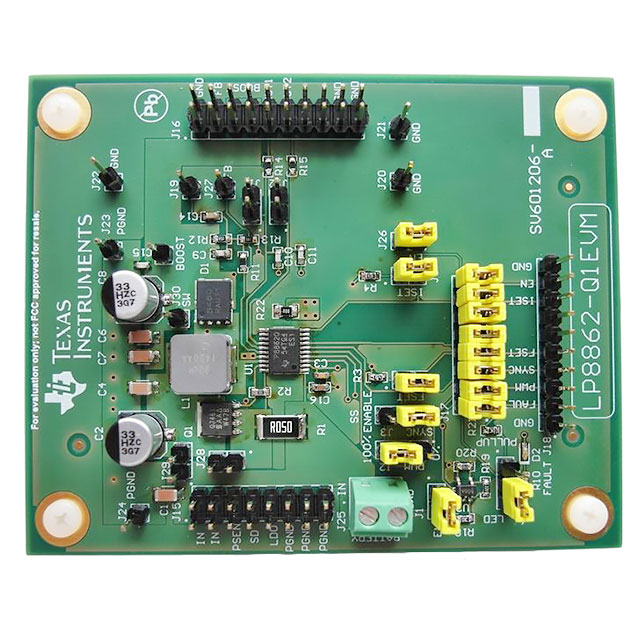
LP8862Q1EVM
ActiveLP8862-Q1 LED DRIVER EVALUATION BOARD AUTOMOTIVE AEC-Q100
Deep-Dive with AI
Search across all available documentation for this part.
LP8862Q1EVM
ActiveLP8862-Q1 LED DRIVER EVALUATION BOARD AUTOMOTIVE AEC-Q100
Deep-Dive with AI
Technical Specifications
Parameters and characteristics for this part
| Specification | LP8862Q1EVM |
|---|---|
| Current - Output / Channel | 160 mA |
| Features | Dimmable |
| Outputs and Type | 2 |
| Outputs and Type | Non-Isolated |
| Supplied Contents | Board(s) |
| Utilized IC / Part | LP8862-Q1 |
| Voltage - Input [Max] | 40 V |
| Voltage - Input [Min] | 4.5 V |
| Voltage - Output | 45 V |
Pricing
Prices provided here are for design reference only. For realtime values and availability, please visit the distributors directly
| Distributor | Package | Quantity | $ | |
|---|---|---|---|---|
| Digikey | Bulk | 1 | $ 94.80 | |
Description
General part information
LP8862-Q1 Series
The LP8862-Q1 is an automotive high-efficiency, low-EMI, easy-to-use LED driver with integrated DC-DC converter. The DC-DC supports both boost and SEPIC modes of operation. The device has two high-precision current sinks that can provide high dimming ratio brightness control with a PWM input signal.
The boost/SEPIC converter has an adaptive output voltage control based on the LED current sink headroom voltages. This feature minimizes power consumption by adjusting the voltage to the lowest sufficient level in all conditions. DC-DC supports spread spectrum for switching frequency and an external synchronization with a dedicated pin. A wide-range adjustable frequency allows the LP8862-Q1 to avoid disturbance for AM radio band.
The input voltage range for the LP8862-Q1 is from 4.5 V to 40 V to support automotive stop/start and load dump conditions. The device supports PWM brightness dimming ratio of 10 000:1 for 100-Hz input PWM frequency. The LP8862-Q1 integrates extensive fault detection features. The device has an option to drive an external p-FET to disconnect the input supply from the system in the event of a fault. This feature also reduces inrush current and standby power consumption.
Documents
Technical documentation and resources
