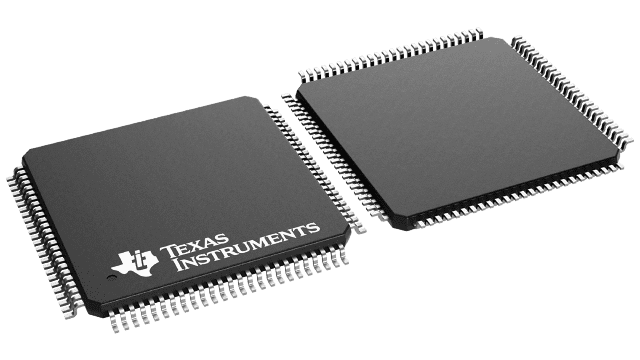
DS90CR484AVJD/NOPB
Active48-BIT LVDS CHANNEL LINK DESERIALIZER WITH INPUT CLOCK SUPPORT FROM 33 MHZ TO 112 MHZ
Deep-Dive with AI
Search across all available documentation for this part.
DS90CR484AVJD/NOPB
Active48-BIT LVDS CHANNEL LINK DESERIALIZER WITH INPUT CLOCK SUPPORT FROM 33 MHZ TO 112 MHZ
Deep-Dive with AI
Technical Specifications
Parameters and characteristics for this part
| Specification | DS90CR484AVJD/NOPB |
|---|---|
| Data Rate | 5.38 Gbps |
| Function | Deserializer |
| Grade | Automotive |
| Input Type | LVDS |
| Mounting Type | Surface Mount |
| Number of Inputs | 8 |
| Number of Outputs | 48 |
| Operating Temperature [Max] | 70 °C |
| Operating Temperature [Min] | -10 °C |
| Output Type | CMOS, TTL |
| Package / Case | 100-TQFP |
| Qualification | AEC-Q100 |
| Supplier Device Package | 100-TQFP (14x14) |
| Voltage - Supply [Max] | 3.6 V |
| Voltage - Supply [Min] | 3 V |
Pricing
Prices provided here are for design reference only. For realtime values and availability, please visit the distributors directly
| Distributor | Package | Quantity | $ | |
|---|---|---|---|---|
| Digikey | Tray | 1 | $ 19.56 | |
| Texas Instruments | JEDEC TRAY (10+1) | 1 | $ 15.54 | |
| 100 | $ 13.57 | |||
| 250 | $ 10.47 | |||
| 1000 | $ 9.36 | |||
Description
General part information
DS90CR484A Series
The DS90CR483A transmitter converts 48 bits of CMOS/TTL data into eight LVDS (Low Voltage Differential Signaling) data streams. A phase-locked transmit clock is transmitted in parallel with the data streams over a ninth LVDS link. Every cycle of the transmit clock 48 bits of input data are sampled and transmitted. The DS90CR484A receiver converts the LVDS data streams back into 48 bits of CMOS/TTL data. At a transmit clock frequency of 112MHz, 48 bits of TTL data are transmitted at a rate of 672Mbps per LVDS data channel. Using a 112MHz clock, the data throughput is 5.38Gbit/s (672Mbytes/s).
The multiplexing of data lines provides a substantial cable reduction. Long distance parallel single-ended buses typically require a ground wire per active signal (and have very limited noise rejection capability). Thus, for a 48-bit wide data and one clock, up to 98 conductors are required. With this Channel Link chipset as few as 19 conductors (8 data pairs, 1 clock pair and a minimum of one ground) are needed. This provides an 80% reduction in cable width, which provides a system cost savings, reduces connector physical size and cost, and reduces shielding requirements due to the cables' smaller form factor.
The 48 CMOS/TTL inputs can support a variety of signal combinations. For example, 6 8-bit words or 5 9-bit (byte + parity) and 3 controls.
Documents
Technical documentation and resources