


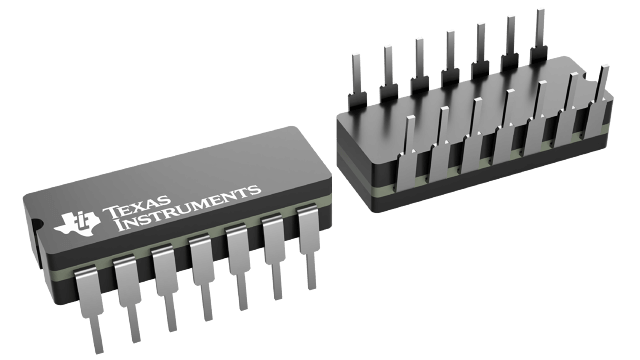
SN54196J
Active50/30/100-MHZ PRESETTABLE DECADE OR BINARY COUNTERS/LATCHES
Deep-Dive with AI
Search across all available documentation for this part.
SN54196J
Active50/30/100-MHZ PRESETTABLE DECADE OR BINARY COUNTERS/LATCHES
Deep-Dive with AI
Technical Specifications
Parameters and characteristics for this part
| Specification | SN54196J |
|---|---|
| Count Rate | 70 MHz |
| Direction | Up |
| Logic Type | Counter, Decade |
| Mounting Type | Through Hole |
| Number of Bits per Element | 4 |
| Number of Elements | 1 |
| Operating Temperature [Max] | 125 °C |
| Operating Temperature [Min] | -55 °C |
| Package / Case | 14-CDIP |
| Reset | Asynchronous |
| Supplier Device Package | 14-CDIP |
| Trigger Type | Negative Edge |
| Voltage - Supply [Max] | 5.5 V |
| Voltage - Supply [Min] | 4.5 V |
Pricing
Prices provided here are for design reference only. For realtime values and availability, please visit the distributors directly
| Distributor | Package | Quantity | $ | |
|---|---|---|---|---|
| Texas Instruments | TUBE | 1 | $ 24.21 | |
| 100 | $ 21.14 | |||
| 250 | $ 16.30 | |||
| 1000 | $ 14.58 | |||
Description
General part information
SN54196 Series
These high-speed monolithic counters consist of four d-c coupled, master-slave flip-flops, which are internally interconnected to provide either a divide-by-two and a divide-by-five counter (’196, ’LS196, ’S196) or a divide-by-two and a divide-by-eight counter (’197, ’LS197, ’S197). These four counters are fully programmable; that is, the outputs may be preset to any state by placing a low on the count/load input and entering the desired data at the data inputs. The outputs will change to agree with the data inputs independent of the state of the clocks.
During the count operation, transfer of information to the outputs occurs on the negative-going edge of the clock pulse. These counters feature a direct clear which when taken low sets all outputs low regardless of the states of the clocks.
These counters may also be used as 4-bit latches by using the count/load input as the strobe and entering data at the data inputs. The outputs will directly follow the data inputs when the count/load is low, but will remain unchanged when the count/load is high and the clock inputs are inactive.
Documents
Technical documentation and resources