


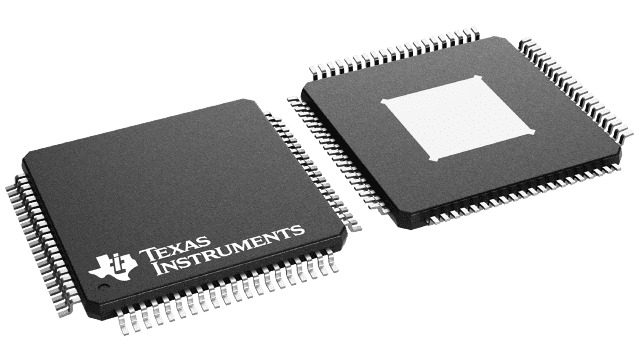
TVP5147PFP
NRND10-BIT HIGH QUALITY SINGLE-CHIP DIGITAL VIDEO DECODER THAT DIGITIZES AND DECODES NTSC/PAL/SECAM
Deep-Dive with AI
Search across all available documentation for this part.
TVP5147PFP
NRND10-BIT HIGH QUALITY SINGLE-CHIP DIGITAL VIDEO DECODER THAT DIGITIZES AND DECODES NTSC/PAL/SECAM
Deep-Dive with AI
Technical Specifications
Parameters and characteristics for this part
| Specification | TVP5147PFP |
|---|---|
| Applications | LCD TV/Monitor |
| Mounting Type | Surface Mount |
| Package / Case | 80-TQFP Exposed Pad |
| Supplier Device Package | 80-HTQFP (12x12) |
| Type | Video Decoder |
| Voltage - Supply, Analog | 3.3 V, 1.8 V |
| Voltage - Supply, Digital | 3.3 V, 1.8 V |
Pricing
Prices provided here are for design reference only. For realtime values and availability, please visit the distributors directly
| Distributor | Package | Quantity | $ | |
|---|---|---|---|---|
| Digikey | Tray | 1 | $ 7.87 | |
| 10 | $ 7.11 | |||
| 25 | $ 6.78 | |||
| 96 | $ 5.88 | |||
| 288 | $ 5.82 | |||
| Texas Instruments | JEDEC TRAY (10+1) | 1 | $ 9.50 | |
| 100 | $ 7.74 | |||
| 250 | $ 6.09 | |||
| 1000 | $ 5.16 | |||
Description
General part information
TVP5147 Series
The TVP5147 device is a high-quality, single-chip digital video decoder that digitizes and decodes all popular baseband analog video formats into digital component video. The TVP5147 decoder supports the analog-to-digital (A/D) conversion of component YPbPr signals, as well as the A/D conversion and decoding of NTSC, PAL, and SECAM composite and S-video into component YCbCr. This decoder includes two 10-bit 30-MSPS A/D converters (ADCs). Preceding each ADC in the device, the corresponding analog channel contains an analog circuit that clamps the input to a reference voltage and applies a programmable gain and offset. A total of 10 video input terminals can be configured to a combination of YPbPr, CVBS, or S-video video inputs.
Composite or S-video signals are sampled at 2× the square-pixel or ITU-R BT.601 clock frequency, line-locked alignment, and are then decimated to the 1× pixel rate. CVBS decoding uses five-line adaptive comb filtering for both the luma and chroma data paths to reduce both cross-luma and cross-chroma artifacts. A chroma trap filter is also available. On CVBS and S-video inputs, the user can control video characteristics such as contrast, brightness, saturation, and hue via an I²C host port interface. Furthermore, luma peaking (sharpness) with programmable gain is included, as well as a patented chroma transient improvement (CTI) circuit.
The following output formats can be selected: 20-bit 4:2:2 YCbCr or 10-bit 4:2:2 YCbCr.
Documents
Technical documentation and resources