


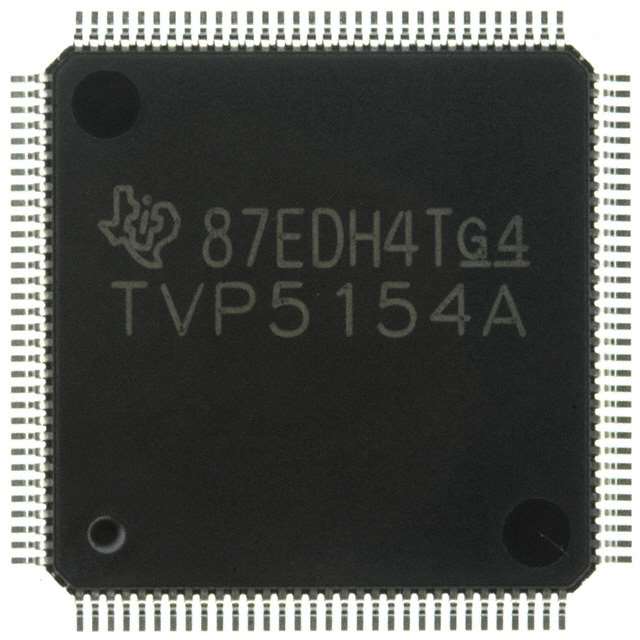
TVP5160PNP
ActiveNTSC/PAL/SECAM/COMPONENT 10-BIT DIGITAL VIDEO DECODER WITH MACROVISIONTM DETECTION, 3D-YC/5-LINE COM
Deep-Dive with AI
Search across all available documentation for this part.
TVP5160PNP
ActiveNTSC/PAL/SECAM/COMPONENT 10-BIT DIGITAL VIDEO DECODER WITH MACROVISIONTM DETECTION, 3D-YC/5-LINE COM
Deep-Dive with AI
Technical Specifications
Parameters and characteristics for this part
| Specification | TVP5160PNP |
|---|---|
| Applications | LCD TV/Monitor |
| Mounting Type | Surface Mount |
| Package / Case | 128-TQFP Exposed Pad |
| Supplier Device Package | 128-HTQFP (14x14) |
| Type | Video Decoder |
| Voltage - Supply, Analog [Max] | 1.95 V |
| Voltage - Supply, Analog [Min] | 1.65 V |
| Voltage - Supply, Digital [Max] [custom] | 1.95 V |
| Voltage - Supply, Digital [Min] [custom] | 1.65 V |
Pricing
Prices provided here are for design reference only. For realtime values and availability, please visit the distributors directly
| Distributor | Package | Quantity | $ | |
|---|---|---|---|---|
| Digikey | N/A | 88 | $ 14.00 | |
| 7181 | $ 14.00 | |||
| Tray | 1 | $ 11.78 | ||
| 10 | $ 10.83 | |||
| 25 | $ 10.38 | |||
| 90 | $ 9.15 | |||
| 270 | $ 8.70 | |||
| 450 | $ 8.14 | |||
| 990 | $ 7.46 | |||
| Texas Instruments | JEDEC TRAY (5+1) | 1 | $ 9.22 | |
| 100 | $ 8.05 | |||
| 250 | $ 6.21 | |||
| 1000 | $ 5.55 | |||
Description
General part information
TVP5160 Series
The TVP5160 device is a high quality, digital video decoder that digitizes and decodes all popular baseband analog video formats into digital component video. The TVP5160 decoder supports the A/D conversion of component YPbPr and RGB (SCART) signals, as well as the A/D conversion and decoding of NTSC, PAL, and SECAM composite and S-Video into component YCbCr. Additionally, component progressive signals can be digitized. The chip includes two 11-bit, 60-MSPS, A/D converters (ADCs). Prior to each ADC, each analog channel contains an analog circuit, which clamps the input to a reference voltage and applies a programmable gain and offset. A total of 12 video input terminals can be configured to a combination of YPbPr, RGB, CVBS, and S-Video video inputs.
Progressive component signals are sampled at 2x clock frequency (54 MHz) and are then decimated to the 1x rate. In SCART mode the component inputs and the CVBS inputs are sampled at 54 MHz alternately, then decimated to the 1x rate. Composite or S-Video signals are sampled at 4x the ITU-R BT.601 clock frequency (54 MHz), line-locked for correct pixel alignment, and are then decimated to the 1x rate. CVBS decoding uses advanced 3D Y/C filtering and 2-dimensional complementary 5-line adaptive comb filtering for both the luma and chroma data paths to reduce both cross-luma and cross-chroma artifacts. 3D Y/C color separation may be used on both PAL and NTSC video signals. A chroma trap filter is also available. On CVBS and Y/C inputs, the user can control video characteristics such as hue, contrast, brightness, and saturation via an I2C host port interface. Furthermore, luma peaking with programmable gain is included, as well as a patented color transient improvement (CTI) circuit. Attenuation at higher frequencies or asymmetrical color subcarrier sidebands are compensated using the IF compensation block. Frame adaptive noise reduction may be applied to reduce temporal noise on CVBS, S-Video, or component inputs.
3D noise reduction and 3D Y/C separation may be used at the same time or independently.
Documents
Technical documentation and resources