Deep-Dive with AI
Search across all available documentation for this part.
Deep-Dive with AI
Technical Specifications
Parameters and characteristics for this part
| Specification | ISL6617AFRZ-TS2568 |
|---|---|
| Applications | PWM Doubler |
| Current - Supply | 6 mA |
| Mounting Type | Surface Mount |
| Operating Temperature [Max] | 125 °C |
| Operating Temperature [Min] | -40 °C |
| Package / Case | 10-VFDFN Exposed Pad |
| Supplier Device Package | 10-DFN (3x3) |
| Voltage - Supply [Max] | 5.5 V |
| Voltage - Supply [Min] | 4.5 V |
Pricing
Prices provided here are for design reference only. For realtime values and availability, please visit the distributors directly
| Distributor | Package | Quantity | $ | |
|---|---|---|---|---|
Description
General part information
ISL6617A Series
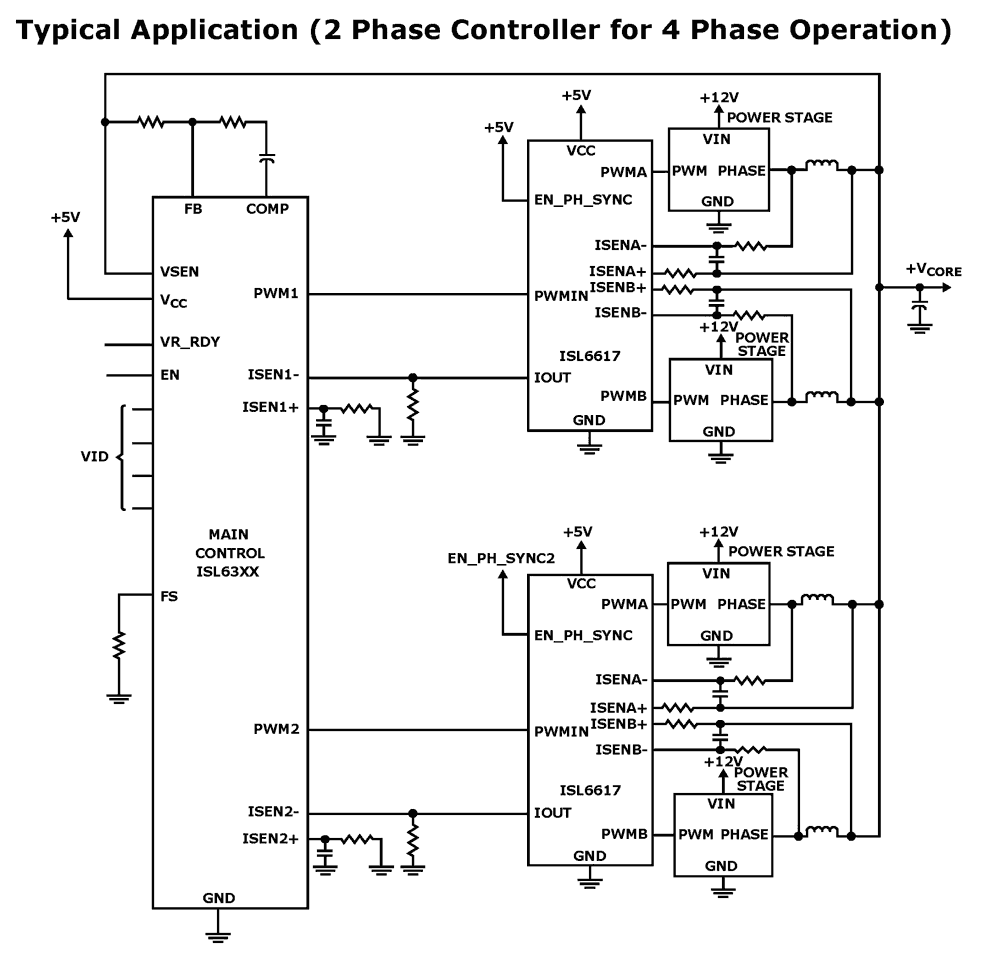
The ISL6617 utilizes Intersil's proprietary Phase Doubler scheme to modulate two-phase power trains with single PWM input. It doubles the number of phases that Intersil's multi-phase controllers ISL63xx can support. When the enable pin (EN_PH_SYNC) is pulled low, the PWM input is pulled high. This simplifies the phase shedding implementation for some Intersil controllers (VR10, VR11, VR11. 1, and VR12 family) that can disable the respective and higher phase(s) by pulling the respective PWM line high. The ISL6617 is designed to minimize the number of analog signals that interface between the controller and drivers in high phase count scalable applications. The common COMP signal, which is usually seen in conventional cascaded configuration, is not required; this improves noise immunity and simplifies the layout. Furthermore, the ISL6617 provides low part count and low cost advantage over the conventional cascaded technique. By cascading the ISL6617 with another ISL6617 or ISL6611A, it can quadruple the number of phases that Intersil's multi-phase controllers ISL63xx can support. The ISL6617 also features Tri-State input and outputs that recognize a high-impedance state, working together with Intersil multiphase PWM controllers and driver stages to prevent negative transients on the controlled output voltage when operation is suspended. This feature eliminates the need for the schottky diode that may be utilized in a power system to protect the load from excessive negative output voltage damage.
Documents
Technical documentation and resources
No documents available