


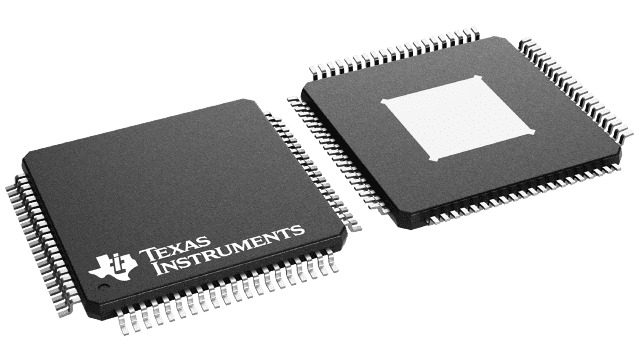
TSB41AB3PFP
ObsoleteIEEE 1394A 3-PORT CABLE TRANSCEIVER/ARBITER
Deep-Dive with AI
Search across all available documentation for this part.
TSB41AB3PFP
ObsoleteIEEE 1394A 3-PORT CABLE TRANSCEIVER/ARBITER
Technical Specifications
Parameters and characteristics for this part
| Specification | TSB41AB3PFP |
|---|---|
| Duplex | Half |
| Mounting Type | Surface Mount |
| Number of Drivers/Receivers [custom] | 6 |
| Number of Drivers/Receivers [custom] | 6 |
| Operating Temperature [Max] | 70 °C |
| Operating Temperature [Min] | 0 °C |
| Package / Case | 80-TQFP Exposed Pad |
| Protocol | IEEE 1394 |
| Supplier Device Package | 80-HTQFP (12x12) |
| Type | Transceiver |
| Voltage - Supply [Max] | 3.6 V |
| Voltage - Supply [Min] | 3 V |
Pricing
Prices provided here are for design reference only. For realtime values and availability, please visit the distributors directly
| Distributor | Package | Quantity | $ | |
|---|---|---|---|---|
| Digikey | N/A | 0 | $ 8.01 | |
| Tray | 1 | $ 10.02 | ||
| 10 | $ 6.96 | |||
| 25 | $ 6.18 | |||
| Texas Instruments | JEDEC TRAY (10+1) | 1 | $ 6.35 | |
| 100 | $ 5.17 | |||
| 250 | $ 4.07 | |||
| 1000 | $ 3.45 | |||
Description
General part information
TSB41AB3 Series
The TSB41AB3 provides the digital and analog transceiver functions required to implement a three-port node in a cable-based IEEE 1394 network. Each cable port incorporates two differential line transceivers. The transceivers include circuitry to monitor the line conditions as needed for determining connection status, for initialization and arbitration, and for packet reception and transmission. The TSB41AB3 is designed to interface with a line layer controller (LLC), such as the TSB12LV21, TSB12LV22, TSB12LV23, TSB12LV26, TSB12LV31, TSB12LV41, TSB12LV42, or TSB12LV01A.
The TSB41AB3 requires only an external 24.576-MHz crystal as a reference. An external clock may be used instead of a crystal. An internal oscillator drives an internal phase-locked loop (PLL), which generates the required 393.216-MHz reference signal. This reference signal is internally divided to provide the clock signals used to control transmission of the outbound encoded strobe and data information. A 49.152-MHz clock signal is supplied to the associated LLC for synchronization of the two chips and is used for resynchronization of the received data. The power-down (PD) function, when enabled by asserting the PD terminal high, stops operation of the PLL.
The TSB41AB3 supports an optional isolation barrier between itself and its LLC. When the ISO\ input terminal is tied high, the LLC interface outputs behave normally. When the ISO\ terminal is tied low, internal differentiating logic is enabled, and the outputs are driven such that they can be coupled through a capacitive or transformer galvanic isolation barrier as described in Annex J of IEEE Std 1394-1995 and in the 1394a-2000 Supplement (section 5.9.4) (hereafter referred to as Annex J type isolation). To operate with TI bus holder isolation, the ISO\ terminal on the PHY must be high.
Documents
Technical documentation and resources