


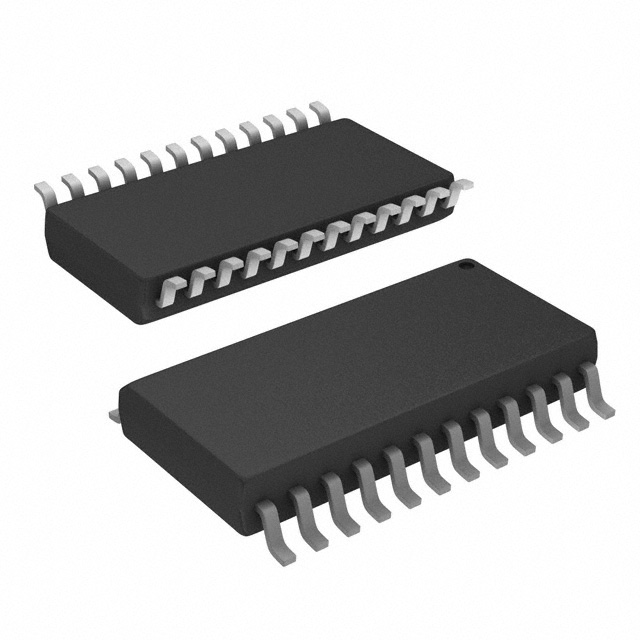
NLV14514BDWR2G
NRND4-BIT TRANSPARENT LATCH/4-TO-16 LINE DECODER/ REEL
Deep-Dive with AI
Search across all available documentation for this part.
NLV14514BDWR2G
NRND4-BIT TRANSPARENT LATCH/4-TO-16 LINE DECODER/ REEL
Deep-Dive with AI
Technical Specifications
Parameters and characteristics for this part
| Specification | NLV14514BDWR2G |
|---|---|
| Circuit | 1 x 4:16 |
| Current - Output High, Low [custom] | 8.8 mA |
| Current - Output High, Low [custom] | 3.5 mA |
| Grade | Automotive |
| Independent Circuits | 1 |
| Mounting Type | Surface Mount |
| Operating Temperature [Max] | 125 °C |
| Operating Temperature [Min] | -55 °C |
| Package / Case | 24-SOIC |
| Package / Case [custom] | 7.5 mm |
| Package / Case [custom] | 0.295 in |
| Qualification | AEC-Q100 |
| Supplier Device Package | 24-SOIC |
| Type | Decoder/Demultiplexer |
| Voltage - Supply [Max] | 18 V |
| Voltage - Supply [Min] | 3 V |
| Voltage Supply Source | Single Supply |
Pricing
Prices provided here are for design reference only. For realtime values and availability, please visit the distributors directly
| Distributor | Package | Quantity | $ | |
|---|---|---|---|---|
| Digikey | Tape & Reel (TR) | 1000 | $ 0.51 | |
| 2000 | $ 0.49 | |||
| 5000 | $ 0.47 | |||
| 10000 | $ 0.46 | |||
| Newark | Each (Supplied on Full Reel) | 1 | $ 0.58 | |
| 3000 | $ 0.54 | |||
| 6000 | $ 0.52 | |||
| 12000 | $ 0.46 | |||
| 18000 | $ 0.45 | |||
| 30000 | $ 0.43 | |||
| ON Semiconductor | N/A | 1 | $ 0.46 | |
Description
General part information
MC14514B Series
The MC14514B and MC14515B are two output options of a 4 to 16 line decoder with latched inputs. The MC14514B (output active high option) presents a logical "1" at the selected output, whereas the MC14515B (output active low option) presents a logical "0" at the selected output. The latches are R-S type flip-flops which hold the last input data presented prior to the strobe transition from "1" to "0". These high and low options of a 4-bit latch/4 to 16 line decoder are constructed with N-channel and P-channel enhancement mode devices in a single monolithic structure. The latches are R-S type flip-flops and data is admitted upon a signal incident at the strobe input, decoded, and presented at the output.These complementary circuits find primary use in decoding applications where low power dissipation and/or high noise immunity is desired.
Documents
Technical documentation and resources