


Deep-Dive with AI
Search across all available documentation for this part.
Deep-Dive with AI
Technical Specifications
Parameters and characteristics for this part
| Specification | SN65LVDS108DBTR |
|---|---|
| Capacitance - Input | 5 pF |
| Current - Supply | 62 mA |
| Data Rate (Max) | 400 Mbps |
| Delay Time | 2.8 ns |
| Input | LVDS |
| Mounting Type | Surface Mount |
| Number of Channels [custom] | 1 |
| Number of Channels [custom] | 1:8 |
| Operating Temperature [Max] | 85 °C |
| Operating Temperature [Min] | -40 °C |
| Output | LVDS |
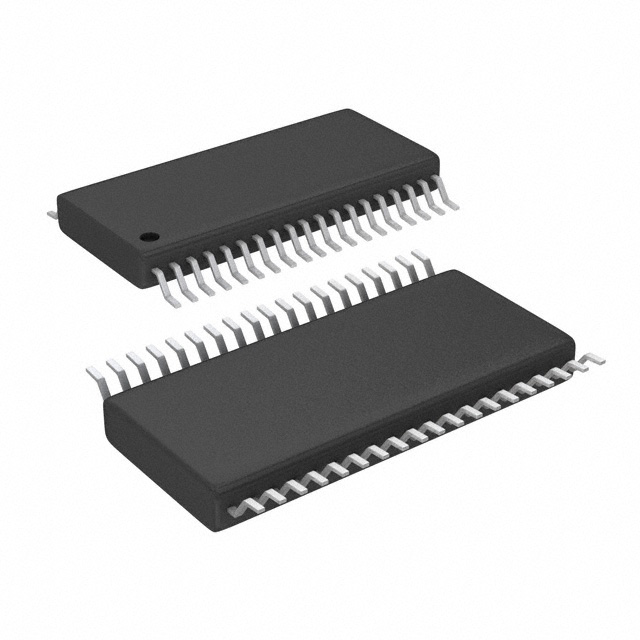
| Package / Case | 38-TFSOP |
| Package / Case [custom] | 4.4 mm |
| Package / Case [custom] | 0.173 in |
| Supplier Device Package | 38-TSSOP |
| Type | Multiplexer, Buffer |
| Voltage - Supply [Max] | 3.6 V |
| Voltage - Supply [Min] | 3 V |
Pricing
Prices provided here are for design reference only. For realtime values and availability, please visit the distributors directly
| Distributor | Package | Quantity | $ | |
|---|---|---|---|---|
| Digikey | Cut Tape (CT) | 1 | $ 7.11 | |
| 10 | $ 6.42 | |||
| 25 | $ 6.12 | |||
| 100 | $ 5.32 | |||
| 250 | $ 5.08 | |||
| 500 | $ 4.63 | |||
| 1000 | $ 4.03 | |||
| Digi-Reel® | 1 | $ 7.11 | ||
| 10 | $ 6.42 | |||
| 25 | $ 6.12 | |||
| 100 | $ 5.32 | |||
| 250 | $ 5.08 | |||
| 500 | $ 4.63 | |||
| 1000 | $ 4.03 | |||
| Tape & Reel (TR) | 2000 | $ 3.69 | ||
| Texas Instruments | LARGE T&R | 1 | $ 5.17 | |
| 100 | $ 4.21 | |||
| 250 | $ 3.31 | |||
| 1000 | $ 2.81 | |||
Description
General part information
SN65LVDS108 Series
The SN65LVDS108 is configured as one differential line receiver connected to eight differential line drivers. Individual output enables are provided for each output and an additional enable is provided for all outputs.
The line receivers and line drivers implement the electrical characteristics of low-voltage differential signaling (LVDS). LVDS, as specified in EIA/TIA-644, is a data signaling technique that offers low power, low noise emission, high noise immunity, and high switching speeds. (Note: The ultimate rate and distance of data transfer is dependent upon the attenuation characteristics of the media, the noise coupling to the environment, and other system characteristics.)
The intended application of this device, and the LVDS signaling technique, is for point-to-point or point-to-multipoint (distributed simplex) baseband data transmission on controlled impedance media of approximately 100. The transmission media may be printed-circuit board traces, backplanes, or cables. The large number of drivers integrated into the same silicon substrate, along with the low pulse skew of balanced signaling, provides extremely precise timing alignment of the signals being repeated from the inputs. This is particularly advantageous for implementing system clock or data distribution trees.
Documents
Technical documentation and resources