


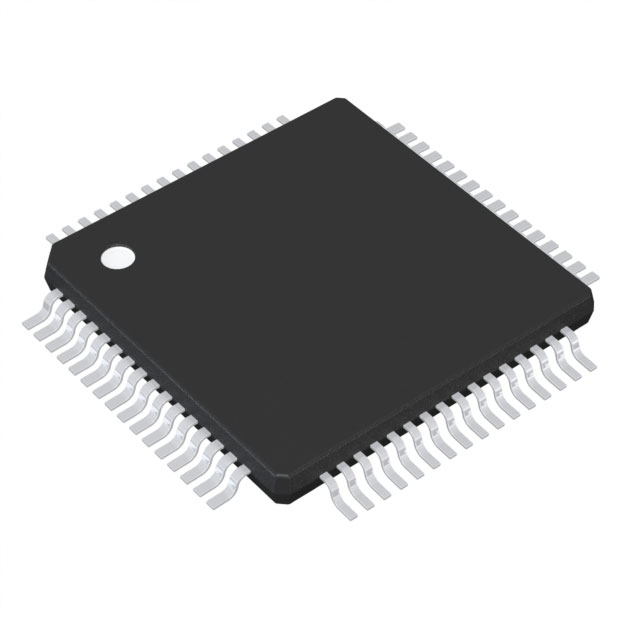
MSP430F2481TPMR
Active16 MHZ MCU WITH 48KB FLASH, 4KB SRAM, COMPARATOR, I2C/SPI/UART, HW MULTIPLIER
Deep-Dive with AI
Search across all available documentation for this part.
MSP430F2481TPMR
Active16 MHZ MCU WITH 48KB FLASH, 4KB SRAM, COMPARATOR, I2C/SPI/UART, HW MULTIPLIER
Deep-Dive with AI
Technical Specifications
Parameters and characteristics for this part
| Specification | MSP430F2481TPMR |
|---|---|
| Connectivity | SCI, I2C, LINbus, SPI, UART/USART, IrDA |
| Core Processor | MSP430 CPU16 |
| Core Size | 16-Bit |
| Mounting Type | Surface Mount |
| Number of I/O | 48 |
| Operating Temperature [Max] | 105 °C |
| Operating Temperature [Min] | -40 °C |
| Oscillator Type | Internal |
| Package / Case | 64-LQFP |
| Program Memory Size | 48 KB |
| Program Memory Type | FLASH |
| RAM Size | 4K x 8 |
| Speed | 16 MHz |
| Supplier Device Package | 64-LQFP (10x10) |
| Voltage - Supply (Vcc/Vdd) [Max] | 3.6 V |
| Voltage - Supply (Vcc/Vdd) [Min] | 1.8 V |
Pricing
Prices provided here are for design reference only. For realtime values and availability, please visit the distributors directly
| Distributor | Package | Quantity | $ | |
|---|---|---|---|---|
| Digikey | Cut Tape (CT) | 1 | $ 8.07 | |
| Digi-Reel® | 1 | $ 8.07 | ||
| Tape & Reel (TR) | 1000 | $ 4.79 | ||
| Texas Instruments | LARGE T&R | 1 | $ 6.40 | |
| 100 | $ 5.22 | |||
| 250 | $ 4.10 | |||
| 1000 | $ 3.48 | |||
Description
General part information
MSP430F2481 Series
The Texas Instruments MSP430 family of ultra-low power microcontrollers consists of several devices featuring different sets of peripherals targeted for various applications. The architecture, combined with five low-power modes, is optimized to achieve extended battery life in portable measurement applications. The device features a powerful 16-bit RISC CPU, 16-bit registers, and constant generators that contribute to maximum code efficiency. The calibrated digitally controlled oscillator (DCO) allows wake-up from low-power modes to active mode in less than 1 µs.
The MSP430F23x, MSP430F24x(1), and MSP430F2410 series are microcontroller configurations with two built-in 16-bit timers, a fast 12-bit A/D converter (not MSP430F24x1), a comparator, four (two in MSP430F23x) universal serial communication interface (USCI) modules, and up to 48 I/O pins. The MSP430F24x1 devices are identical to the MSP430F24x devices, with the exception that the ADC12 module is not implemented. The MSP430F23x devices are identical to the MSP430F24x devices, with the exception that a reduced Timer_B, one USCI module, and less RAM are integrated.
Typical applications include sensor systems, industrial control applications, and hand-held meters.
Documents
Technical documentation and resources