Deep-Dive with AI
Search across all available documentation for this part.
Deep-Dive with AI
Technical Specifications
Parameters and characteristics for this part
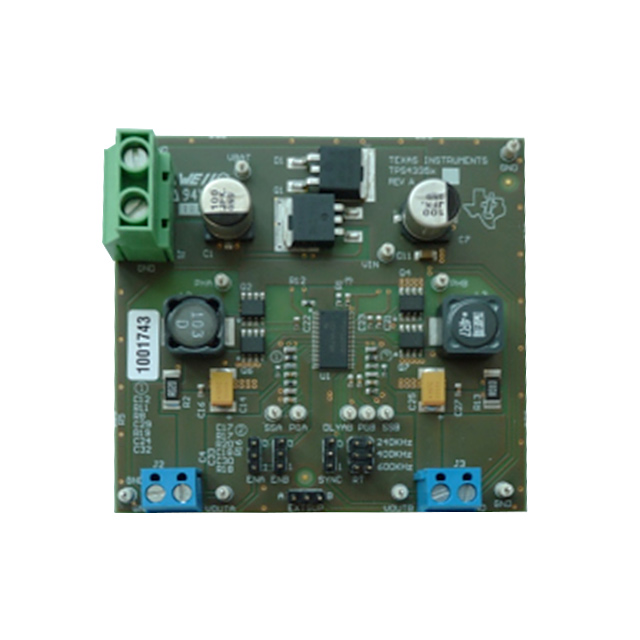
| Specification | TPS43350EVM |
|---|---|
| Board Type | Fully Populated |
| Current - Output | 4 A, 2 A |
| Frequency - Switching | 400 kHz, 600 kHz, 240 kHz |
| Main Purpose | DC/DC, Step Down |
| Outputs and Type | 2 |
| Outputs and Type | Non-Isolated |
| Regulator Topology | Buck |
| Supplied Contents | Board(s) |
| Utilized IC / Part | TPS43350 |
| Voltage - Input [Max] | 40 V |
| Voltage - Input [Min] | 4 V |
| Voltage - Output | 5 V, 3.3 V |
Pricing
Prices provided here are for design reference only. For realtime values and availability, please visit the distributors directly
| Distributor | Package | Quantity | $ | |
|---|---|---|---|---|
| Digikey | Box | 1 | $ 118.80 | |
Description
General part information
TPS43350-Q1 Series
The TPS43350-Q1 and TPS43351-Q1 include two current-mode synchronous buck controllers designed for the harsh environment in automotive applications. The devices are ideal for use in a multi-rail system with low quiescent requirements, as they automatically operate in low-power mode (consuming typically 30 µA) at light loads. The devices offer protection features such as thermal, soft-start, and overcurrent protection. During short-circuit conditions of the regulator output, activation of the current-foldback feature can limit the current through the MOSFETs for control of power dissipation. The two independent soft-start inputs allow ramp-up of the output voltage independently during start-up.
The programmable range of the switching frequency is from 150 kHz to 600 kHz, as is the frequency of an external clock to which the devices can synchronize. Additionally, the TPS43351-Q1 offers frequency-hopping spread-spectrum operation.
The TPS43350-Q1 and TPS43351-Q1 include two current-mode synchronous buck controllers designed for the harsh environment in automotive applications. The devices are ideal for use in a multi-rail system with low quiescent requirements, as they automatically operate in low-power mode (consuming typically 30 µA) at light loads. The devices offer protection features such as thermal, soft-start, and overcurrent protection. During short-circuit conditions of the regulator output, activation of the current-foldback feature can limit the current through the MOSFETs for control of power dissipation. The two independent soft-start inputs allow ramp-up of the output voltage independently during start-up.
Documents
Technical documentation and resources