


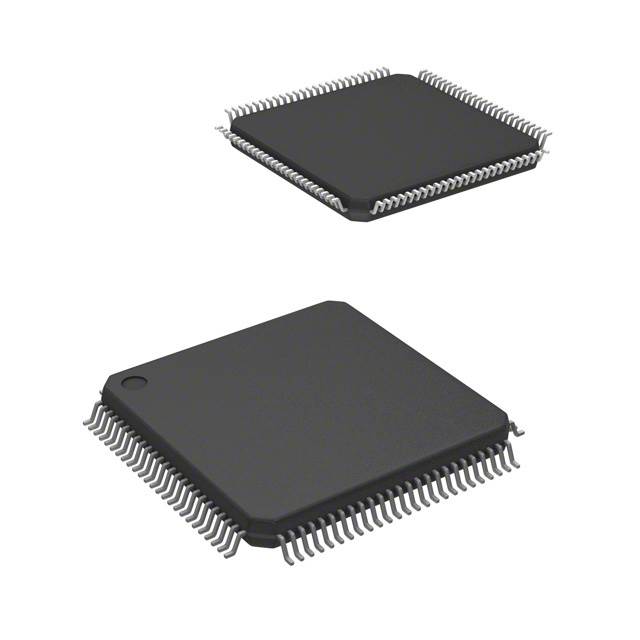
MSP430F4794IPZR
Active16-MHZ SINGLE-PHASE METERING MCU WITH 4 SIGMA-DELTA ADCS, 160-SEGMENT LCD, 60KB FLASH, 2.5KB RAM
Deep-Dive with AI
Search across all available documentation for this part.
MSP430F4794IPZR
Active16-MHZ SINGLE-PHASE METERING MCU WITH 4 SIGMA-DELTA ADCS, 160-SEGMENT LCD, 60KB FLASH, 2.5KB RAM
Deep-Dive with AI
Technical Specifications
Parameters and characteristics for this part
| Specification | MSP430F4794IPZR |
|---|---|
| Connectivity | SCI, I2C, LINbus, SPI, UART/USART, IrDA |
| Core Processor | MSP430 CPU16 |
| Core Size | 16-Bit |
| Data Converters [custom] | 4 |
| Data Converters [custom] | 16 |
| Mounting Type | Surface Mount |
| Number of I/O | 72 |
| Operating Temperature [Max] | 85 °C |
| Operating Temperature [Min] | -40 °C |
| Oscillator Type | Internal |
| Package / Case | 100-LQFP |
| Peripherals | POR, WDT, LCD, Brown-out Detect/Reset, PWM |
| Program Memory Size | 60 KB |
| Program Memory Type | FLASH |
| Speed | 16 MHz |
| Supplier Device Package | 100-LQFP (14x14) |
| Voltage - Supply (Vcc/Vdd) [Max] | 3.6 V |
| Voltage - Supply (Vcc/Vdd) [Min] | 1.8 V |
Pricing
Prices provided here are for design reference only. For realtime values and availability, please visit the distributors directly
| Distributor | Package | Quantity | $ | |
|---|---|---|---|---|
| Digikey | Cut Tape (CT) | 1 | $ 10.21 | |
| 10 | $ 9.22 | |||
| 25 | $ 8.80 | |||
| 100 | $ 7.64 | |||
| 250 | $ 7.29 | |||
| 500 | $ 6.65 | |||
| Digi-Reel® | 1 | $ 10.21 | ||
| 10 | $ 9.22 | |||
| 25 | $ 8.80 | |||
| 100 | $ 7.64 | |||
| 250 | $ 7.29 | |||
| 500 | $ 6.65 | |||
| Tape & Reel (TR) | 1000 | $ 5.31 | ||
| Texas Instruments | LARGE T&R | 1 | $ 7.82 | |
| 100 | $ 6.37 | |||
| 250 | $ 5.01 | |||
| 1000 | $ 4.25 | |||
Description
General part information
MSP430F4794 Series
The Texas Instruments MSP430 family of ultra-low power microcontrollers consists of several devices featuring different sets of peripherals targeted for various applications. The architecture, combined with five low-power modes is optimized to achieve extended battery life in portable measurement applications. The device features a powerful 16-bit RISC CPU, 16-bit registers, and constant generators that contribute to maximum code efficiency. The digitally controlled oscillator (DCO) allows wake-up from low-power modes to active mode in less than 6µs.
The MSP430F47xx series are microcontroller configurations targeted to single phase electricity meters with three or four 16-bit sigma-delta A/D converters. Each channel has a differential input pair and programmable input gain. Also integrated are two 16-bit timers, three universal serial communication interfaces (USCI), 72 I/O pins, and a liquid crystal driver (LCD) with integrated contrast control.
The Texas Instruments MSP430 family of ultra-low power microcontrollers consists of several devices featuring different sets of peripherals targeted for various applications. The architecture, combined with five low-power modes is optimized to achieve extended battery life in portable measurement applications. The device features a powerful 16-bit RISC CPU, 16-bit registers, and constant generators that contribute to maximum code efficiency. The digitally controlled oscillator (DCO) allows wake-up from low-power modes to active mode in less than 6µs.
Documents
Technical documentation and resources