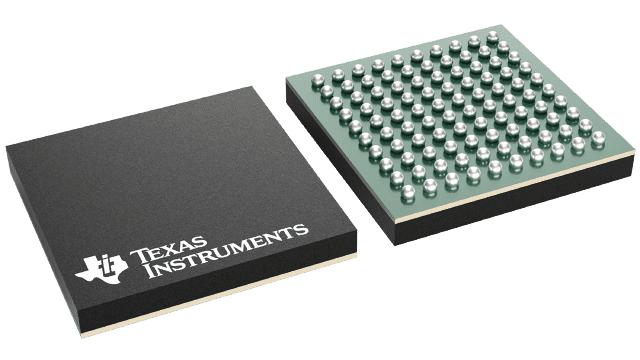
DDC264CKZAWR
Active64-CHANNEL, CURRENT-INPUT ANALOG-TO-DIGITAL CONVERTER
Deep-Dive with AI
Search across all available documentation for this part.
DDC264CKZAWR
Active64-CHANNEL, CURRENT-INPUT ANALOG-TO-DIGITAL CONVERTER
Deep-Dive with AI
Technical Specifications
Parameters and characteristics for this part
| Specification | DDC264CKZAWR |
|---|---|
| Architecture | Sigma-Delta |
| Configuration | ADC |
| Data Interface | SPI |
| Features | Simultaneous Sampling |
| Input Type | Single Ended |
| Mounting Type | Surface Mount |
| Number of A/D Converters | 32 |
| Number of Bits | 20 |
| Number of Inputs | 64 |
| Operating Temperature [Max] | 70 °C |
| Operating Temperature [Min] | 0 °C |
| Package / Case | 100-LFBGA |
| Reference Type | External |
| Sampling Rate (Per Second) | 6k |
| Supplier Device Package | 100-NFBGA (9x9) |
| Voltage - Supply, Analog | 5 V |
| Voltage - Supply, Digital [Max] | 5.25 V |
| Voltage - Supply, Digital [Min] | 2.7 V |
Pricing
Prices provided here are for design reference only. For realtime values and availability, please visit the distributors directly
| Distributor | Package | Quantity | $ | |
|---|---|---|---|---|
| Digikey | Tape & Reel (TR) | 1000 | $ 119.74 | |
| Texas Instruments | LARGE T&R | 1 | $ 127.40 | |
| 100 | $ 123.57 | |||
| 250 | $ 102.88 | |||
| 1000 | $ 95.79 | |||
Description
General part information
DDC264 Series
The DDC264 is a 20-bit, 64-channel, current-input analog-to-digital (A/D) converter. It combines both current-to-voltage and A/D conversion so that 64 separate low-level current output devices, such as photodiodes, can be directly connected to its inputs and digitized.
For each of the 64 inputs, the DDC264 uses the proven dual switched integrator front-end. This configuration allows for continuous current integration: while one integrator is being digitized by the onboard A/D converter, the other is integrating the input current. This architecture provides both a very stable offset and a loss-less collection of the input current. Adjustable integration times range from 160 µs to 1 s, allowing currents from fAs to µAs to be continuously measured with outstanding precision.
The DDC264 has a serial interface designed for daisy-chaining in multi-device systems. Simply connect the output of one device to the input of the next to create the chain. Common clocking feeds all the devices in the chain so that the digital overhead in a multi-DDC264 system is minimal.