


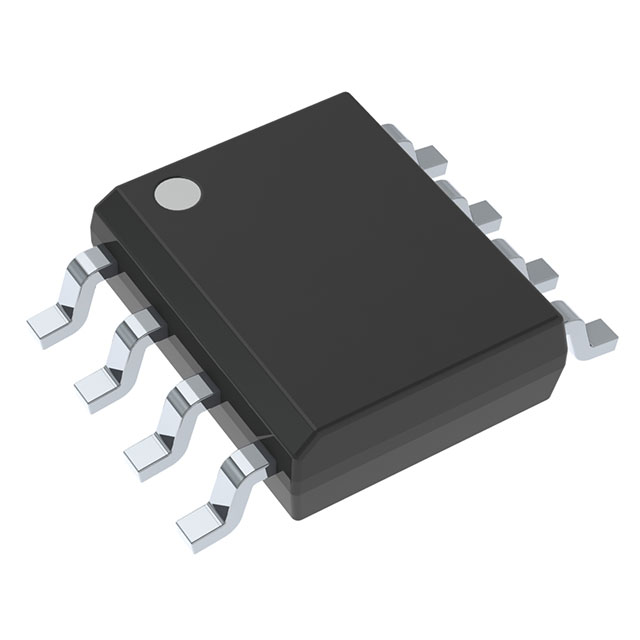
TPS92023DR
ActiveRESONANT-SWITCHING DRIVER CONTROLLER FOR LED LIGHTING
Deep-Dive with AI
Search across all available documentation for this part.
TPS92023DR
ActiveRESONANT-SWITCHING DRIVER CONTROLLER FOR LED LIGHTING
Deep-Dive with AI
Technical Specifications
Parameters and characteristics for this part
| Specification | TPS92023DR |
|---|---|
| Applications | Lighting, Backlight |
| Internal Switch(s) | False |
| Mounting Type | Surface Mount |
| Number of Outputs | 1 |
| Operating Temperature [Max] | 125 ¯C |
| Operating Temperature [Min] | -40 °C |
| Package / Case | 8-SOIC |
| Package / Case [x] | 0.154 in |
| Package / Case [y] | 3.9 mm |
| Supplier Device Package | 8-SOIC |
| Topology | Half-Bridge |
| Type | DC DC Controller |
| Voltage - Supply (Max) [Max] | 18 V |
| Voltage - Supply (Min) [Min] | 11.5 V |
Pricing
Prices provided here are for design reference only. For realtime values and availability, please visit the distributors directly
| Distributor | Package | Quantity | $ | |
|---|---|---|---|---|
| Digikey | Cut Tape (CT) | 1 | $ 2.03 | |
| Digi-Reel® | 1 | $ 2.03 | ||
| Tape & Reel (TR) | 2500 | $ 0.93 | ||
| 5000 | $ 0.90 | |||
| Texas Instruments | LARGE T&R | 1 | $ 1.53 | |
| 100 | $ 1.26 | |||
| 250 | $ 0.91 | |||
| 1000 | $ 0.68 | |||
Description
General part information
TPS92023 Series
The TPS92023 is a high-performance resonant- switching LED driver controller. It is designed for use in higher power LED lighting systems. The TPS92023 uses resonant switching in an LLC topology to achieve a very high efficiency compared to traditional half-bridge converters.
The programmable dead time enables zero-voltage switching with minimum magnetizing current, maximizing system efficiency across a variety of applications.
The TPS92023 can operate in two switching frequency modes. Fixed frequency allows for simple design when the load current is constant while variable switching allows for optimal closed-loop control for loads with varying currents. The internal oscillator supports the switching frequencies from 30 kHz to 380 kHz. This high-accuracy oscillator realizes the minimum switching frequency limiting with 4% tolerance, allowing the designer to avoid of the power stage and, thus, further reducing overall system cost.
Documents
Technical documentation and resources
No documents available