


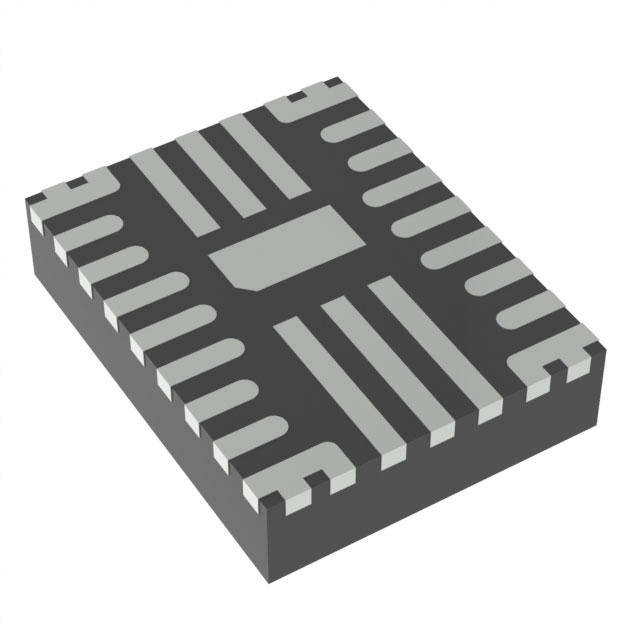
TPS25862QRPQRQ1
ActiveUSB TYPE-C® + TYPE-A DUAL CHARGING PORTS CONTROLLER WITH LOAD SHEDDING & USB ON/OFF CONTROL, 2.2 MHZ
Deep-Dive with AI
Search across all available documentation for this part.
TPS25862QRPQRQ1
ActiveUSB TYPE-C® + TYPE-A DUAL CHARGING PORTS CONTROLLER WITH LOAD SHEDDING & USB ON/OFF CONTROL, 2.2 MHZ
Technical Specifications
Parameters and characteristics for this part
| Specification | TPS25862QRPQRQ1 |
|---|---|
| Applications | USB Type C |
| Current - Supply | 21 µA |
| Grade | Automotive |
| Mounting Type | Surface Mount |
| Operating Temperature [Max] | 125 °C |
| Operating Temperature [Min] | -40 °C |
| Package / Case | 25-PowerVFQFN |
| Qualification | AEC-Q100 |
| Supplier Device Package | 25-VQFN-HR |
| Supplier Device Package [x] | 3.5 |
| Supplier Device Package [y] | 4.5 |
| Voltage - Supply [Max] | 26 V |
| Voltage - Supply [Min] | 5.5 V |
Pricing
Prices provided here are for design reference only. For realtime values and availability, please visit the distributors directly
| Distributor | Package | Quantity | $ | |
|---|---|---|---|---|
| Digikey | N/A | 0 | $ 3.13 | |
| Tape & Reel (TR) | 3000 | $ 2.71 | ||
| Texas Instruments | LARGE T&R | 1 | $ 4.08 | |
| 100 | $ 3.58 | |||
| 250 | $ 2.51 | |||
| 1000 | $ 2.02 | |||
Description
General part information
TPS25862 Series
The TPS2586x-Q1 is an integrated USB charging port solution, which includes a synchronous, high efficiency DC/DC converter and integrated detection and control for implementing USB Battery Charging 1.2 and Type-C ports.
The TPS2586x-Q1 is a family of highly-integrated USB charging controller for Type-C and Type-A dual ports application.
The device integrates a monolithic, synchronous, rectified, step-down, switch-mode converter with internal power MOSFETs and two USB current-limit switches with charging port auto-detection. The TPS2586x-Q1 offers a compact solution with excellent load and line regulation over a wide input supply range. The synchronous buck regulator operates with peak-current mode control and is internally compensated to simplify the design. A resistor on the FREQ pin sets the switching frequency between 200 kHz and 3 MHz. Operating below 400 kHz results in better system efficiency and operation above 2.1 MHz avoids the AM radio bands and allows for use of a smaller inductor.