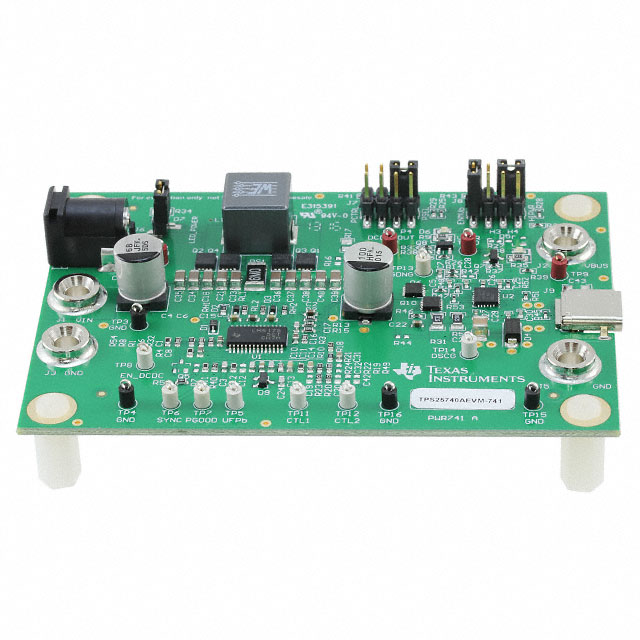
TPS25740AEVM-741
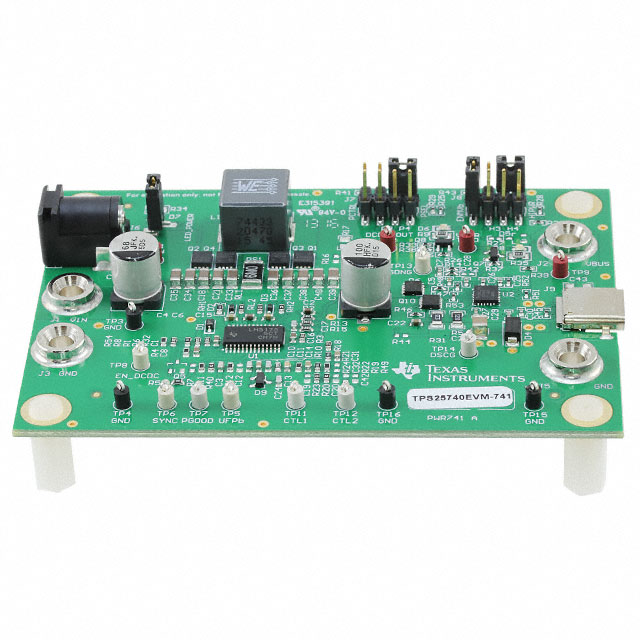
ObsoleteEVAL BOARD FOR TPS25740A
Deep-Dive with AI
Search across all available documentation for this part.
TPS25740AEVM-741
ObsoleteEVAL BOARD FOR TPS25740A
Deep-Dive with AI
Technical Specifications
Parameters and characteristics for this part
| Specification | TPS25740AEVM-741 |
|---|---|
| Function | USB Type-C® |
| Supplied Contents | Board(s) |
| Type | Interface |
| Utilized IC / Part | LM5175, TPS25740A |
Pricing
Prices provided here are for design reference only. For realtime values and availability, please visit the distributors directly
| Distributor | Package | Quantity | $ | |
|---|---|---|---|---|
Description
General part information
TPS25740A Series
The TPS25740B, a fully compliant and USB Power Delivery (PD) 2.0 certified solution, implements a power source for USB Type-C™ PD. It is easy to use and minimizes time to market because there is no firmware or external microcontroller required, just connect it to the board. The device offers four voltages with a maximum voltage and power up to20 V at 100 W. The TPS25740B automatically handles all USB PD negotiations, handshakes using the CC pins, and selects the voltage from the power supply using the CTLx pins. The PCTRL pin allows for dynamically reducing the amount of power advertised to enable port power management. The TPS25740B integrates functions such as OVP, OCP, ESD, UVLO, OTSD, and VBUS discharge to help save solution size and cost while enabling a safe and robust design. The TPS25740B controls an N-ch MOSFET for the VBUS switch, saving system cost versus solutions that require a P-ch MOSFET. The ultra-low standby power of the TPS25740B makes it easier to pass energy efficiency standards and extends battery life in mobile applications.
The TPS25740B typically draws 8.5 µA (or 5.8 µA if VDD = 3.3 V) when no device is attached. Additional system power saving is achievable by using the Port Attachment Indicator (DVDD) output to disable the power source when no device is attached.
Protection features include overvoltage protection, overcurrent protection, over-temperature protection, IEC for CC pins, and system override to disable the gate driver (GD).
Documents
Technical documentation and resources