


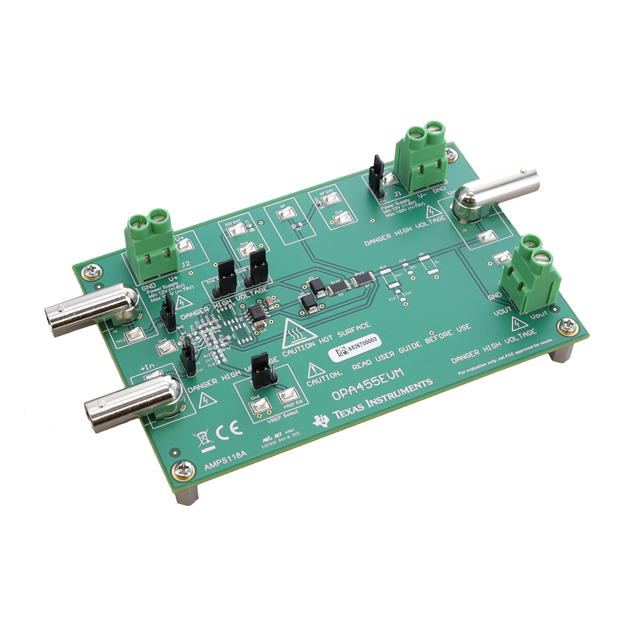
OPA455EVM
Active150-V, WIDE BANDWIDTH 6.5-MHZ, H
Deep-Dive with AI
Search across all available documentation for this part.
OPA455EVM
Active150-V, WIDE BANDWIDTH 6.5-MHZ, H
Deep-Dive with AI
Technical Specifications
Parameters and characteristics for this part
| Specification | OPA455EVM |
|---|---|
| -3db Bandwidth | 6.5 MHz |
| Amplifier Type | General Purpose |
| Board Type | Fully Populated |
| Channels per IC | 1 - Single |
| Current - Output / Channel | 45 mA |
| Current - Supply (Main IC) | 3.2 mA |
| Slew Rate | 32 V/çs |
| Supplied Contents | Board(s) |
| Utilized IC / Part | OPA455 |
| Voltage - Supply, Single/Dual (±) [Max] | 75 V, 150 V |
| Voltage - Supply, Single/Dual (±) [Min] | -6 V, 12 V |
Pricing
Prices provided here are for design reference only. For realtime values and availability, please visit the distributors directly
| Distributor | Package | Quantity | $ | |
|---|---|---|---|---|
| Digikey | Box | 1 | $ 118.80 | |
Description
General part information
OPA455 Series
The OPA455 is a high-voltage (150-V), high current drive (45-mA), unity-gain stable operational amplifier with a gain-bandwidth product of 6.5 MHz and slew rate of 32 V/us. As a result of the amplifier wide output range, this device is an excellent choice for high-voltage piezo driving, avalance photodiode biasing, and high-voltage Howland current pump or voltage output stages.
The OPA455 is internally protected against overtemperature conditions and current overloads. The device is fully specified to perform over a wide power-supply range of ±6 V to ±75 V, or on a single supply of 12 V to 150 V. The status flag is an open-drain output that allows the device to be easily referenced to standard, low-voltage, logic circuitry. This high-voltage operational amplifier provides excellent accuracy and wide output swing, and is free from phase-inversion problems that are often found in similar amplifiers.
The output can be disabled using the enable-disable (E/D) pin. The E/D pin has a common return pin to allow for easy interface to low-voltage logic circuitry. This disable is accomplished without disturbing the input signal path, not only saving power but also protecting the load.
Documents
Technical documentation and resources

