


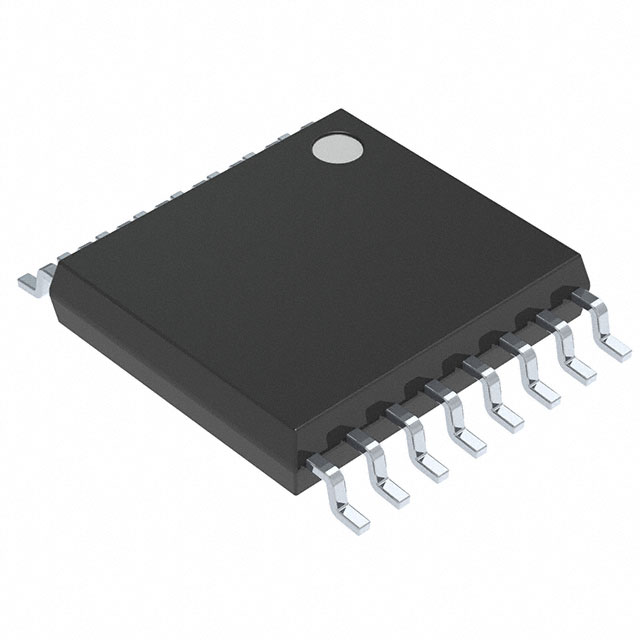
PCA9654EDTR2G
ObsoleteI/O EXPANDER, I<SUP>2</SUP>C / SMBUS, 8-BIT, WITH INTERRUPT
Deep-Dive with AI
Search across all available documentation for this part.
PCA9654EDTR2G
ObsoleteI/O EXPANDER, I<SUP>2</SUP>C / SMBUS, 8-BIT, WITH INTERRUPT
Deep-Dive with AI
Technical Specifications
Parameters and characteristics for this part
| Specification | PCA9654EDTR2G |
|---|---|
| Clock Frequency | 100 kHz |
| Features | POR |
| Interface | I2C |
| Interrupt Output | True |
| Mounting Type | Surface Mount |
| Number of I/O | 8 |
| Operating Temperature [Max] | 125 °C |
| Operating Temperature [Min] | -55 °C |
| Package / Case | 16-TSSOP |
| Package / Case [x] | 0.173 in |
| Package / Case [y] | 4.4 mm |
| Supplier Device Package | 16-TSSOP |
| Voltage - Supply [Max] | 5.5 V |
| Voltage - Supply [Min] | 1.65 V |
Pricing
Prices provided here are for design reference only. For realtime values and availability, please visit the distributors directly
| Distributor | Package | Quantity | $ | |
|---|---|---|---|---|
| Digikey | Cut Tape (CT) | 1 | $ 3.03 | |
| 10 | $ 2.27 | |||
| 25 | $ 2.08 | |||
| 100 | $ 1.87 | |||
| 250 | $ 1.77 | |||
| 500 | $ 1.71 | |||
| 1000 | $ 1.66 | |||
| Digi-Reel® | 1 | $ 4.35 | ||
| 10 | $ 2.81 | |||
| 25 | $ 2.41 | |||
| 100 | $ 1.96 | |||
| 250 | $ 1.73 | |||
| 500 | $ 1.60 | |||
| 1000 | $ 1.48 | |||
| Tape & Reel (TR) | 2500 | $ 1.47 | ||
| Newark | Each (Supplied on Full Reel) | 1 | $ 1.84 | |
| 3000 | $ 1.76 | |||
| 6000 | $ 1.64 | |||
| 12000 | $ 1.53 | |||
| 18000 | $ 1.47 | |||
| 30000 | $ 1.45 | |||
Description
General part information
PCA9654E Series
The PCA9654E provides 8 bits of General Purpose parallelInput/Output (GPIO) expansion for I2C−bus/SMBus applications.The PCA9654E consists of 8−bit Configuration (Input or Output selection); Input, Output and Polarity Inversion (active HIGH or active LOW operation) registers. The system master may set the I/Os as either inputs or outputs by writing to the I/O configuration bits. The data for each Input or Output is kept in the corresponding Input or Output register. The polarity of the read register can be inverted with the Polarity Inversion register. All registers can be read by the system master.The PCA9654E open−drain interrupt (INTb) output is activated when any input state differs from its corresponding input port register state and is used to indicate to the system master that an input state has changed. The power−on reset sets the registers to their default values and initializes the device state machine.Three hardware pins (AD0, AD1, AD2) vary the fixed I2C bus address and allow up to 64 devices to share the same I2C−bus/SMBus.
Documents
Technical documentation and resources