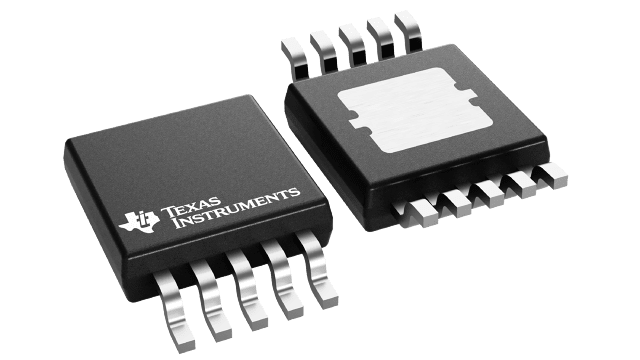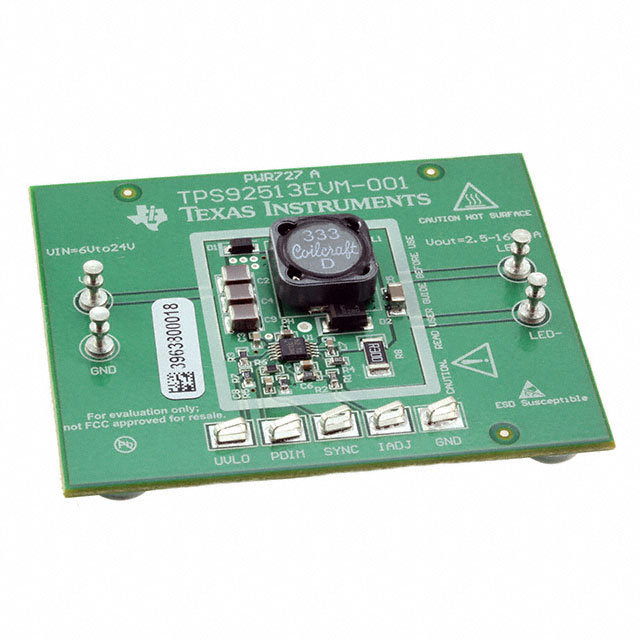
TPS92513EVM-001
ActiveTPS92513HV LED DRIVER EVALUATION BOARD
Deep-Dive with AI
Search across all available documentation for this part.
TPS92513EVM-001
ActiveTPS92513HV LED DRIVER EVALUATION BOARD
Deep-Dive with AI
Technical Specifications
Parameters and characteristics for this part
| Specification | TPS92513EVM-001 |
|---|---|
| Contents | Board(s) |
| Current - Output / Channel | 1 A |
| Features | Dimmable |
| Outputs and Type | 1 |
| Outputs and Type | Non-Isolated, 1 Non-Isolated Output |
| Supplied Contents | Board(s) |
| Utilized IC / Part | TPS92513HV |
| Voltage - Input [Max] | 24 V |
| Voltage - Input [Min] | 6 V |
| Voltage - Output [Max] | 16 V |
| Voltage - Output [Min] | 2.5 V |
Pricing
Prices provided here are for design reference only. For realtime values and availability, please visit the distributors directly
| Distributor | Package | Quantity | $ | |
|---|---|---|---|---|
| Digikey | Box | 1 | $ 58.80 | |
| N/A | 0 | $ 58.80 | ||
Description
General part information
TPS92513 Series
The TPS92513/HV are 1.5A step-down (buck) current regulators with an integrated MOSFET to drive high current LEDs. Available with 42 V and 60 V (HV) input ranges, these LED drivers operate at a user selected fixed-frequency with peak-current mode control and deliver excellent line and load regulation.
The TPS92513/HV LED drivers feature separate inputs for analog and pulse width modulation (PWM) dimming for no compromise brightness control achieving contrast ratios of greater than 10:1 and greater than 100:1, respectively. The PWM input is compatible with low-voltage logic standards for easy interface to a broad range of microcontrollers. The analog LED current setpoint is adjustable from 0 V to 300 mV using the IADJ input with an external 0 V to 1.8 V signal.
For multi-string applications using two or more TPS92513/HV LED drivers, the internal oscillator can be overdriven by an external clock ensuring all of the converters operate at a common frequency thereby reducing the potential for beat frequencies and simplifying system EMI filtering. An adjustable input under-voltage lockout (UVLO) with hysteresis provides flexibility in setting start/stop voltages based upon supply voltage conditions.
Documents
Technical documentation and resources