ISL55100BIRZ
ActiveQUAD 18V PIN ELECTRONICS DRIVER/WINDOW COMPARATOR
Deep-Dive with AI
Search across all available documentation for this part.
ISL55100BIRZ
ActiveQUAD 18V PIN ELECTRONICS DRIVER/WINDOW COMPARATOR
Deep-Dive with AI
Technical Specifications
Parameters and characteristics for this part
| Specification | ISL55100BIRZ |
|---|---|
| Logic Type | Comparator, Driver |
| Mounting Type | Surface Mount |
| Number of Bits | 4 |
| Operating Temperature [Max] | 85 °C |
| Operating Temperature [Min] | -40 °C |
| Package / Case | 72-VFQFN Exposed Pad |
| Supplier Device Package | 72-QFN (10x10) |
| Supply Voltage [Max] | 18 V |
| Supply Voltage [Min] | 9 V |
Pricing
Prices provided here are for design reference only. For realtime values and availability, please visit the distributors directly
Description
General part information
ISL55100A Series
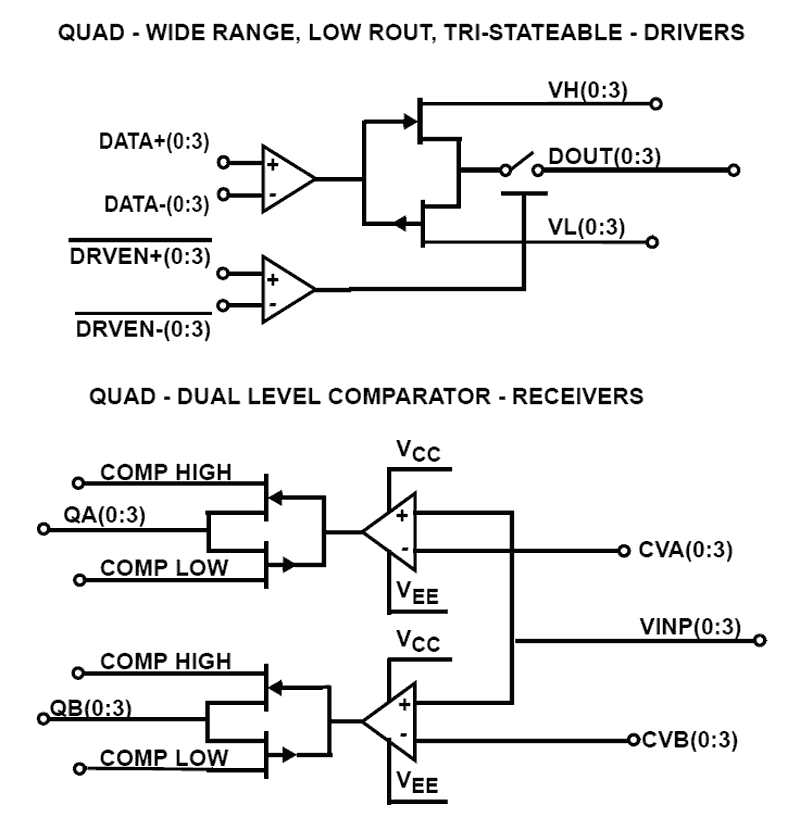
The ISL55100A is a quad pin driver and window comparator fabricated in a wide voltage CMOS process. It is designed specifically for Test During Burn-In (TDBI) applications, where cost, functional density and power are all at a premium. This IC incorporates four channels of programmable drivers and window comparators into a small 72 Ld QFN package. Each channel has independent driver levels, data and high impedance control. Each receiver has dual comparators, which provide high and low threshold levels. The ISL55100A uses differential mode digital inputs and can therefore mate directly with LVDS or CML outputs. Single-ended logic families are handled by connecting one of the digital input pins to an appropriate threshold voltage (e.g., 1.4V for TTL compatibility). The comparator outputs are single-ended and the output levels are user-defined to mate directly with any digital technology. The 18V driver output and receiver input ranges allow this device to interface directly with TTL, ECL, CMOS (3V, 5V and 7V), LVCMOS, and custom level circuitry, as well as the high voltage (super voltage) level required for many special test modes for Flash devices.
Documents
Technical documentation and resources