


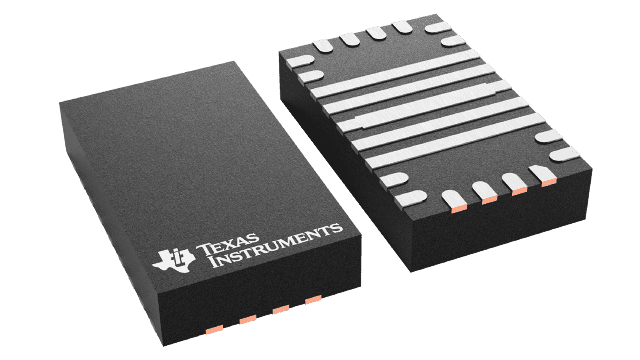
TPS55287RYQR
Active36V 4A BUCK-BOOST CONVERTER WITH I²C INTERFACE
Deep-Dive with AI
Search across all available documentation for this part.
TPS55287RYQR
Active36V 4A BUCK-BOOST CONVERTER WITH I²C INTERFACE
Deep-Dive with AI
Technical Specifications
Parameters and characteristics for this part
| Specification | TPS55287RYQR |
|---|---|
| Current - Output | 4 A |
| Frequency - Switching [Max] | 2.2 MHz |
| Frequency - Switching [Min] | 200 kHz |
| Function | Step-Up/Step-Down |
| Mounting Type | Surface Mount |
| Number of Outputs | 1 |
| Operating Temperature [Max] | 125 °C |
| Operating Temperature [Min] | -40 C |
| Output Configuration | Positive |
| Output Type | Programmable |
| Supplier Device Package | 21-VQFN-HR (3x5) |
| Synchronous Rectifier | True |
| Topology | Buck-Boost |
| Voltage - Input (Max) [Max] | 36 V |
| Voltage - Input (Min) [Min] | 3 V |
| Voltage - Output (Max) [Max] | 22 V |
| Voltage - Output (Min/Fixed) | 0.8 V |
Pricing
Prices provided here are for design reference only. For realtime values and availability, please visit the distributors directly
| Distributor | Package | Quantity | $ | |
|---|---|---|---|---|
| Digikey | N/A | 1435 | $ 4.80 | |
| Texas Instruments | LARGE T&R | 1 | $ 3.43 | |
| 100 | $ 3.01 | |||
| 250 | $ 2.11 | |||
| 1000 | $ 1.70 | |||
Description
General part information
TPS55287 Series
The TPS55287 is a synchronous buck-boost converter that is optimized for converting battery voltage or adapter voltage into power supply rails. The TPS55287 integrates four MOSFET switches, providing a compact solution for USB power delivery (USB PD) application.
The TPS55287 has up to 36V input voltage capability. Through the I2C interface, the output voltage of the TPS55287 can be programmed from 0.8V to 22V with 10mV step. When working in boost mode, the device can deliver 35W from a 12V input. It is capable of delivering 25W from 9V input voltage.
The TPS55287 employs an average current-mode control scheme. The switching frequency is programmable from 200kHz to 2.2MHz by an external resistor and can be synchronized to an external clock. The TPS55287 also provides optional spread spectrum to minimize peak EMI.
Documents
Technical documentation and resources