


Deep-Dive with AI
Search across all available documentation for this part.
Deep-Dive with AI
Technical Specifications
Parameters and characteristics for this part
| Specification | T2D120A15M |
|---|---|
| Delay Time | True |
| Delay Time | 5 Min |
| Function | On-Delay |
| Mounting Type | Chassis Mount |
| Relay Type | Solid State Relay |
| Termination Style | Quick Connect - 0.250" (6.3mm) |
| Timing Adjustment Method | Screwdriver Slot |
| Timing Initiate Method | Trigger Signal, Input Voltage |
| Voltage - Supply [Max] | 230 VAC |
| Voltage - Supply [Min] | 120 VAC |
Pricing
Prices provided here are for design reference only. For realtime values and availability, please visit the distributors directly
Description
General part information
T2D120A15M Series
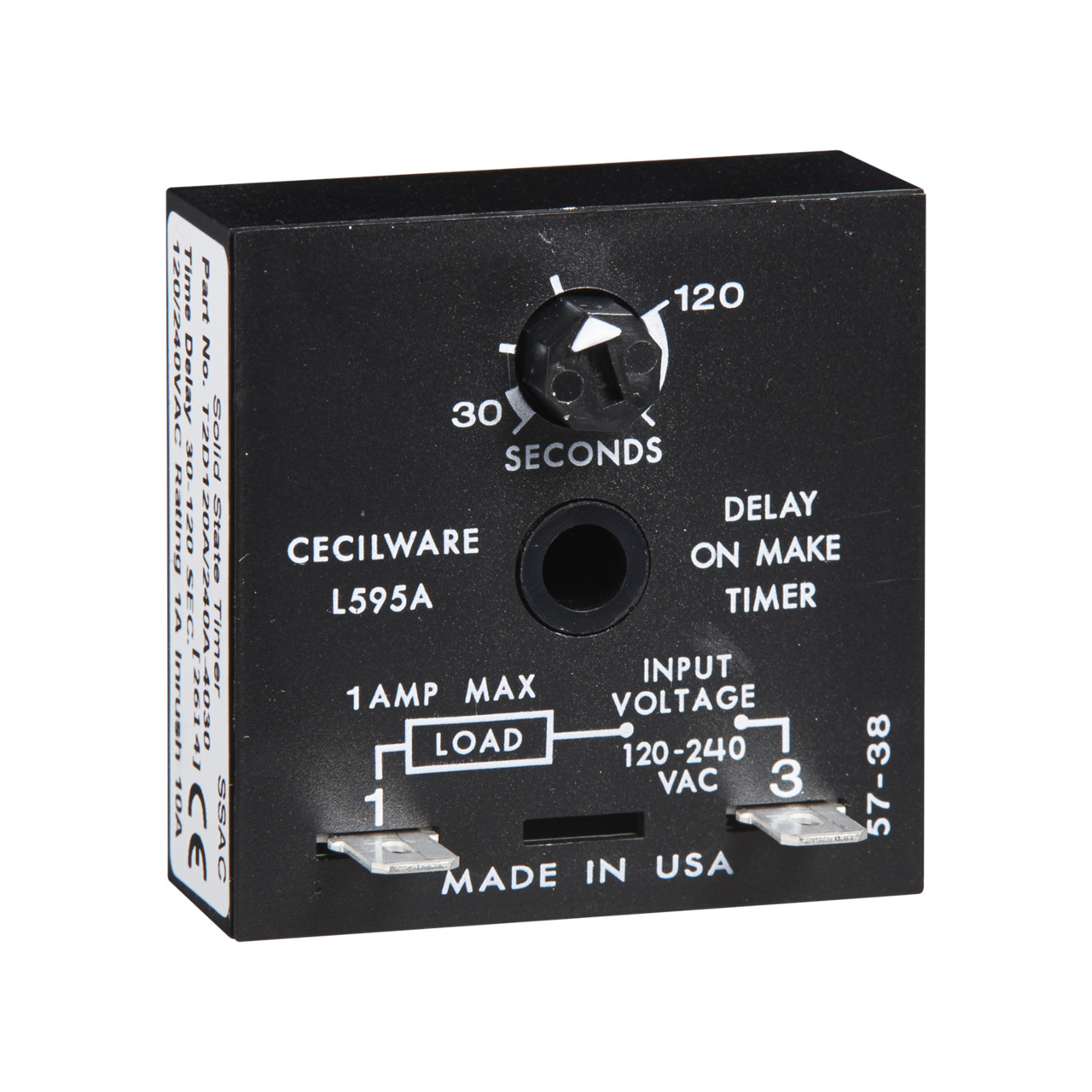
The T2D Series provides protection against short cycling of compressors and other motors. At the end of each operation, a lockout delay prevents restarting the compressor or motor until the delay is completed. 24VAC models can be used with thermostats that include a cooling anticipator resistor. It can be connected in series with the load for delay-on-make operation. Operation (Lockout with Random Start)Connection #1: Upon application of input voltage, a random start time delay begins. At the end of this time delay, the output is energized.Lockout Delay: Input voltage must be applied prior to and during timing. When the thermostat or initiate switch opens, the output de-energizes and the lockout time delay begins. At the end of the lockout delay, the output is energized allowing the load to immediately energize when the initiate switch or thermostat closes.Connection #2: Upon application of input voltage and closure of initiate switch, the time delay begins. At the end of the time delay, the output is energized and remains energized until power is removed.Reset: Removing power resets the output and the time delay.
Documents
Technical documentation and resources