


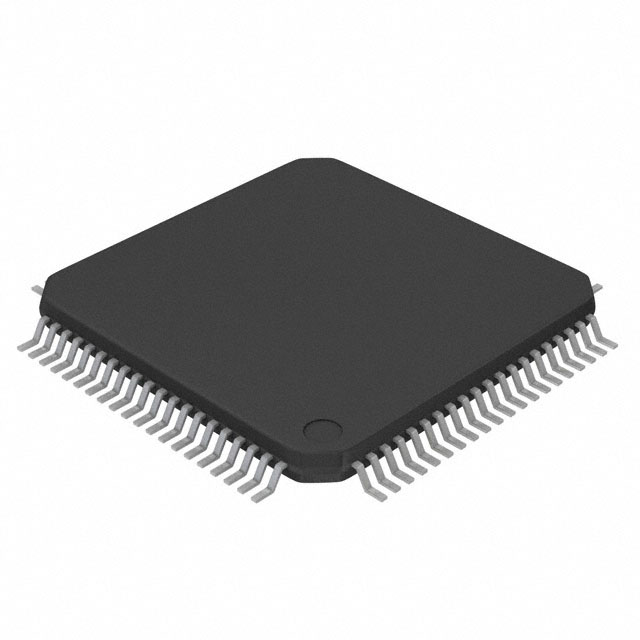
SN74ABTH32316PN
Active16-BIT TRI-PORT UNIVERSAL BUS EXCHANGERS
Deep-Dive with AI
Search across all available documentation for this part.
SN74ABTH32316PN
Active16-BIT TRI-PORT UNIVERSAL BUS EXCHANGERS
Deep-Dive with AI
Technical Specifications
Parameters and characteristics for this part
| Specification | SN74ABTH32316PN |
|---|---|
| Current - Output High, Low [custom] | 64 mA |
| Current - Output High, Low [custom] | 32 mA |
| Logic Type | Universal Bus Exchanger |
| Mounting Type | Surface Mount |
| Number of Circuits | 16-Bit, Tri-Port |
| Operating Temperature [Max] | 85 °C |
| Operating Temperature [Min] | -40 C |
| Package / Case | 80-LQFP |
| Voltage - Supply [Max] | 5.5 V |
| Voltage - Supply [Min] | 4.5 V |
Pricing
Prices provided here are for design reference only. For realtime values and availability, please visit the distributors directly
| Distributor | Package | Quantity | $ | |
|---|---|---|---|---|
| Digikey | N/A | 0 | $ 15.60 | |
| 4830 | $ 15.60 | |||
| Tray | 119 | $ 16.53 | ||
| Texas Instruments | JEDEC TRAY (10+1) | 1 | $ 17.87 | |
| 100 | $ 15.61 | |||
| 250 | $ 12.04 | |||
| 1000 | $ 10.77 | |||
Description
General part information
74ABTH32316 Series
The 'ABTH32316 consist of three 16-bit registered input/output (I/O) ports. These registers combine D-type latches and flip-flops to allow data flow in transparent, latch, and clock modes. Data from one input port can be exchanged to one or more of the other ports. Because of the universal storage element, multiple combinations of real-time and stored data can be exchanged among the three ports.
Data flow in each direction is controlled by the output-enable (OEA\, OEB\, and OEC\), select-control (SELA, SELB, and SELC), latch-enable (LEA, LEB, and LEC), and clock (CLKA, CLKB, and CLKC) inputs. The A data register operates in the transparent mode when LEA is high. When LEA is low, data is latched if CLKA is held at a high or low logic level. If LEA and clock-enable A (CLKENA\) are low, data is stored on the low-to-high transition of CLKA. Output data selection is accomplished by the select-control pins. All three ports have active-low output enables, so when the output-enable input is low, the outputs are active; when the output-enable input is high, the outputs are in the high-impedance state.
When VCCis between 0 and 2.1 V, the device is in the high-impedance state during power up or power down. However, to ensure the high-impedance state above 2.1 V, OE\ should be tied to VCCthrough a pullup resistor; the minimum value of the resistor is determined by the current-sinking capability of the driver.
Documents
Technical documentation and resources