


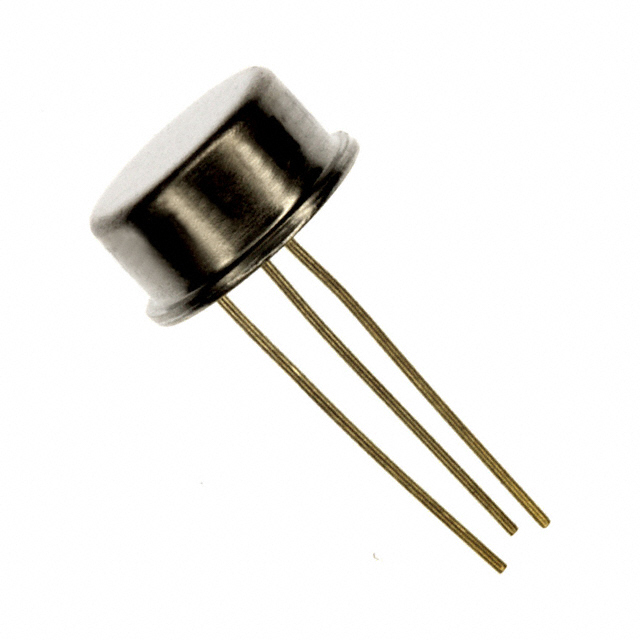
LM109H/NOPB
ActiveEXTENDED TEMPERATURE 1A 5V OUTPUT LINEAR REGULATOR / LDO
Deep-Dive with AI
Search across all available documentation for this part.
LM109H/NOPB
ActiveEXTENDED TEMPERATURE 1A 5V OUTPUT LINEAR REGULATOR / LDO
Technical Specifications
Parameters and characteristics for this part
| Specification | LM109H/NOPB |
|---|---|
| Current - Output | 200 mA |
| Current - Quiescent (Iq) | 5.2 mA |
| Current - Supply (Max) [Max] | 10 mA |
| Mounting Type | Through Hole |
| Number of Regulators | 1 |
| Operating Temperature [Max] | 150 °C |
| Operating Temperature [Min] | -55 °C |
| Output Configuration | Positive |
| Output Type | 1.81 mOhm |
| Package / Case | TO-39-3 Metal Can, TO-205AD |
| Protection Features | Over Current, Over Temperature |
| Voltage - Input (Max) [Max] | 25 V |
| Voltage - Output (Min/Fixed) | 5.05 V |
Pricing
Prices provided here are for design reference only. For realtime values and availability, please visit the distributors directly
| Distributor | Package | Quantity | $ | |
|---|---|---|---|---|
| Digikey | Bulk | 1 | $ 13.56 | |
| 10 | $ 12.46 | |||
| 25 | $ 11.94 | |||
| 100 | $ 11.37 | |||
| Texas Instruments | BULK | 1 | $ 17.36 | |
| 100 | $ 15.16 | |||
| 250 | $ 11.69 | |||
| 1000 | $ 10.46 | |||
Description
General part information
LM109 Series
The LM109 series are complete 5V regulators fabricated on a single silicon chip. They are designed for local regulation on digital logic cards, eliminating the distribution problems association with single-point regulation. The devices are available in two standard transistor packages. In the solid-kovar TO-5 header, it can deliver output currents in excess of 200 mA, if adequate heat sinking is provided. With the TO-3 power package, the available output current is greater than 1A.
The regulators are essentially blowout proof. Current limiting is included to limit the peak output current to a safe value. In addition, thermal shutdown is provided to keep the IC from overheating. If internal dissipation becomes too great, the regulator will shut down to prevent excessive heating.
Considerable effort was expended to make these devices easy to use and to minimize the number of external components. It is not necessary to bypass the output, although this does improve transient response somewhat. Input bypassing is needed, however, if the regulator is located very far from the filter capacitor of the power supply. Stability is also achieved by methods that provide very good rejection of load or line transients as are usually seen with TTL logic.
Documents
Technical documentation and resources